

If your RV water tastes like a swimming pool, smells chemical, or leaves your skin and hair feeling unusually dry, a carbon filter may help. But the right filter depends on which disinfectant is in the water.
Most public water systems use either free chlorine or chloramine to control microorganisms as water travels through distribution pipes. These disinfectants are not interchangeable. A standard activated carbon filter is generally well suited for reducing free chlorine, while chloramine requires a more reactive media, usually catalytic carbon, and enough contact time for the reaction to occur.
That distinction matters for RV owners because many campground filters are compact and designed for high flow. A filter that works well at one campground may perform differently at another if the water chemistry, disinfectant, flow rate, or filter media changes.
This article explains how chlorine and chloramine differ, how to identify the disinfectant at your campground, which filter media to consider, and how to set up your RV water filtration system for better results.
The short answer: standard carbon handles chlorine; catalytic carbon is needed for chloramine
Here is the practical comparison:
| Water disinfectant | What it is | Does it dissipate quickly? | Typical filter media |
|---|---|---|---|
| Free chlorine | A chlorine-based disinfectant remaining in water as a free residual | Relatively quickly compared with chloramine | Standard activated carbon, GAC, or carbon block |
| Chloramine | Usually monochloramine, formed by combining chlorine and ammonia | No; it is much more stable | Catalytic activated carbon, properly sized for the flow |
| Chlorine plus other contaminants | A mixed campground water profile | Depends on the contaminant | Sediment plus carbon and specialty stages as needed |
The word carbon alone does not tell you whether a filter is designed to reduce chloramine. Carbon block describes the physical form of a filter. It does not automatically mean the carbon is catalytic or certified for chloramine reduction.
For free chlorine, a quality activated carbon filter is often enough to improve taste and odor and substantially reduce the disinfectant. For chloramine, look for explicit performance information stating that the media is designed or tested for chloramine reduction. If the manufacturer only mentions chlorine reduction, do not assume chloramine will be removed.
What is free chlorine?
Free chlorine is the disinfectant most people picture when they think about treated water. A utility adds chlorine or a chlorine compound to water, and some of that disinfectant remains available as a free residual after treatment.
That residual helps maintain protection as water moves through pipes. However, free chlorine is relatively reactive and volatile. It can react with organic material, pipe surfaces, and other substances. It also dissipates more readily when water is exposed to air.
That is why free chlorine often creates a noticeable swimming-pool odor or taste, particularly when the water has been sitting in a hose or RV holding tank. It is also why standard activated carbon is effective: chlorine reacts readily at the carbon surface.
How standard activated carbon reduces chlorine
Activated carbon has a highly porous structure that provides a large surface area. Depending on the carbon type and water conditions, it reduces chlorine through a combination of adsorption and chemical reaction.
The most common options are:
- Granular activated carbon, or GAC: Loose carbon granules contained inside a cartridge or tank.
- Carbon block: Activated carbon compressed into a solid filter block.
- Carbon composite media: Carbon combined with other materials for sediment or specialty reduction.
For free chlorine, both GAC and carbon block can work well when the filter is correctly sized and operated within its rated flow range. A carbon block may provide more consistent water contact through the media, while GAC can offer a large volume of carbon in some designs.
The important factors are not just the words “carbon filter” on the label. Pay attention to:
- The contaminant claim.
- The rated capacity.
- The recommended flow rate.
- The physical size and amount of carbon.
- Whether the filter has a relevant certification or performance test.
What is chloramine?
Chloramine is a disinfectant formed when chlorine reacts with ammonia. The most common form used in drinking-water treatment is monochloramine.
Utilities use chloramine because it remains stable longer than free chlorine. That persistence helps maintain a disinfectant residual across long distribution networks, including areas far from the treatment plant.
Chloramine is not simply “stronger chlorine.” It behaves differently in water and requires a different treatment approach.
Why municipalities switch from chlorine to chloramine
A water utility may choose chloramine for several operational reasons:
- It can maintain a more stable residual over long distances.
- It may help utilities manage regulated disinfection by-products associated with free chlorine.
- It can reduce the need for repeated chlorine boosting in some distribution systems.
- It can provide a consistent secondary disinfectant throughout the water network.
The decision is made by the utility based on its treatment process, source water, distribution system, regulations, and operating goals. Some utilities use free chlorine year-round. Others use chloramine year-round or switch disinfectants seasonally.
The U.S. Environmental Protection Agency provides background information on chloramines in drinking water, and the CDC explains how chlorine and chloramine are used for water disinfection in this drinking-water resource.
Why chloramine is harder to remove
Chloramine is more stable and less volatile than free chlorine. It does not disappear quickly just because water sits in an open container, and boiling is not a dependable way to remove it.
This creates two common misunderstandings:
- “My water sat overnight, so the disinfectant must be gone.”
- “My regular chlorine carbon filter removes all forms of chlorine.”
Neither assumption is reliable for chloraminated water.
Standard activated carbon may reduce some chloramine under certain conditions, but performance can vary widely. A small, fast-flowing RV cartridge may not provide enough reactive surface area or contact time for dependable reduction.
How to find out whether a campground uses chlorine or chloramine
The most useful first step is to identify the water source. Campgrounds can receive water from a municipal system, a private well, a community water system, or a combination of sources. The disinfectant may change from one location to the next.
1. Ask the campground or water utility
Ask a specific question:
“Does this water supply use free chlorine or chloramine as the secondary disinfectant?”
A campground employee may not know the answer, but they may be able to tell you the supplying utility. The utility’s water-quality department can usually provide the most reliable information.
If you stay at a campground for an extended period, ask whether the campground has a recent water-quality report or whether it is supplied by the local city or county system.
2. Check the campground or utility water report
A municipal Consumer Confidence Report or water-quality report may list:
- Chlorine residual.
- Chloramine or total chlorine.
- Disinfectant levels.
- The treatment process.
- Seasonal changes in disinfection.
- The name of the source or supplying utility.
Look for terms such as free chlorine, chlorine residual, combined chlorine, monochloramine, chloramine, or total chlorine.
A report showing both free and total chlorine can sometimes help identify the situation. However, interpretation depends on the testing method and reporting units. When in doubt, contact the utility rather than trying to infer the answer from one number.
3. Use an appropriate field test
Water test strips and kits vary considerably. A strip intended for pool water, chlorine dioxide, hardness, or total dissolved solids may not accurately answer whether your drinking water contains chloramine.
Some tests measure:
- Free chlorine.
- Total chlorine.
- Combined chlorine.
- Chlorine dioxide.
- Chloramine through a specific reagent method.
A useful field approach may involve testing free chlorine and total chlorine, then comparing the results. But inexpensive strips can be affected by water temperature, expiration, storage conditions, timing, and concentration range.
The RV Water Filter Store’s water test collection includes different types of testing products. Review the specific test’s intended use before relying on it for chlorine or chloramine decisions. A hardness strip or TDS meter can provide useful information about other water conditions, but it does not identify the disinfectant.
4. Do not mistake odor for a laboratory result
A strong pool-like odor may suggest free chlorine, but odor alone cannot identify the disinfectant. Chloramine can also contribute to taste and odor complaints, and some people detect disinfectants more readily than others.
Use odor as a reason to investigate: not as the final diagnosis.
Which carbon media removes chlorine and chloramine?

Standard activated carbon: the practical choice for free chlorine
Standard activated carbon is usually the first choice for reducing free chlorine, taste, and odor in RV water.
It may be found in:
- Inline RV filters.
- Carbon block cartridges.
- Dual-canister systems.
- Under-sink drinking-water filters.
- Larger whole-RV filtration systems.
A carbon cartridge certified or tested for chlorine reduction can be a good fit when the campground uses free chlorine and the water does not have unusual iron, sulfur, sediment, or other treatment needs.
The RV water filtration systems collection includes whole-RV system configurations with sediment and carbon stages. A sediment stage before carbon is useful because particles can occupy the carbon surface and restrict flow, reducing the effectiveness and service life of the carbon cartridge.
Catalytic carbon: the preferred media for chloramine
Catalytic carbon is activated carbon that has been manufactured or treated to create a more reactive surface. Rather than relying only on adsorption, catalytic carbon promotes the breakdown of chloramine.
For chloraminated water, look for:
- The words catalytic carbon in the technical specifications.
- An explicit chloramine-reduction claim.
- A tested capacity at a stated flow rate.
- A recommended contact time or bed depth.
- Certification or performance data that specifically names chloramine.
Catalytic carbon can be used in granular form, block form, or larger treatment beds. The format is less important than the media chemistry, amount of media, and time the water spends in contact with it.
A small carbon cartridge labeled only for chlorine may improve taste but still allow significant chloramine to pass through.
KDF: a possible supporting media, not an automatic chloramine solution
KDF is a copper-zinc media used in some water filters. Depending on the formulation and water conditions, it can help with chlorine, certain metals, scale-related issues, and microbial control inside a filter.
KDF can be useful as part of a multi-stage system, but it should not automatically be treated as a replacement for catalytic carbon when chloramine reduction is the primary objective.
If chloramine is your concern, verify the manufacturer’s specific performance data. A filter containing KDF may still require catalytic carbon for dependable chloramine reduction.
Reverse osmosis does not replace the carbon prefilter
Reverse osmosis is designed primarily to reduce dissolved solids and many dissolved contaminants. It should not automatically be considered the primary barrier for chloramine.
Chloramine can damage some thin-film composite RO membranes over time. If an RV has an under-sink RO or drinking-water system, carbon pretreatment is especially important when the supply contains chloramine.
Use a carbon or catalytic-carbon stage ahead of the membrane, following the RO manufacturer’s instructions. The needed media and replacement interval depend on the disinfectant level, water usage, flow, and membrane specifications.
NSF/ANSI 42: useful, but read the exact claim
NSF/ANSI 42 covers aesthetic effects such as taste, odor, and chlorine reduction. It can be a helpful reference when comparing carbon filters, but the certification must be interpreted carefully.
A filter described as NSF/ANSI 42 certified for chlorine reduction has been evaluated for a specified chlorine claim under defined test conditions. That does not necessarily mean the filter has been tested for chloramine.
When reviewing a product label or performance sheet, ask:
- Does it say chlorine or chloramine?
- Is the claim certified, independently tested, or simply stated by the seller?
- What flow rate was used?
- What capacity was tested?
- Is the claim for taste and odor only, or for a measured reduction?
- Does the test match the way you use the filter in your RV?
For a free-chlorine campground, NSF/ANSI 42 chlorine-reduction information is generally more relevant. For a chloramine campground, look for a specific chloramine claim and catalytic carbon media.
Contact time can determine whether the filter works
Even the right media can underperform if water moves through it too quickly.
The key concept is contact time: how long water remains in contact with the carbon. Water treatment professionals may describe this using empty-bed contact time, or EBCT:
EBCT = carbon-bed volume ÷ flow rate
You do not need to calculate EBCT for every campground stop, but the principle is important. A larger carbon bed and lower flow provide more opportunity for the media to react with chloramine.
Why RV flow makes this challenging
RV owners often want strong flow for:
- Showers.
- Multiple faucets.
- Toilet flushing.
- Washing dishes.
- Filling tanks.
- Using an outside sprayer.
A compact filter connected to a high-flow supply may have only a short contact period. That may be adequate for free chlorine but insufficient for chloramine reduction.
To improve performance:
- Use a filter designed for the actual flow rate.
- Avoid exceeding the cartridge’s rated capacity.
- Choose a larger cartridge or multi-stage system when appropriate.
- Replace clogged sediment cartridges promptly.
- Use a dedicated point-of-use system for drinking water if whole-RV flow demands are high.
- Do not assume a slower shower proves the filter is working better; excessive restriction can create other problems.
A pressure regulator protects RV plumbing from excessive campground pressure, but it does not remove chlorine or chloramine. It is a separate part of the water-management setup.
Signs that chloramine may be affecting your RV
Chloramine is not automatically a sign that campground water is unsafe. Public utilities regulate disinfectant levels, and the EPA sets a maximum residual disinfectant level for chloramines. The filtration question is about taste, odor, equipment protection, and personal preference: not about treating regulated municipal water as inherently dangerous.
That said, persistent chloramine exposure may contribute to problems in sensitive equipment or materials.
Rubber seals, gaskets, and elastomers
Some rubber materials can degrade when exposed to chloraminated water over time. Possible signs include:
- Black or greasy particles near faucets or hoses.
- Crumbling or sticky rubber components.
- Leaks around seals and gaskets.
- Premature failure of certain flexible parts.
- A recurring rubbery odor or taste.
The exact outcome depends on the material, temperature, disinfectant concentration, age, and exposure time. Do not assume every rubber failure is caused by chloramine; wear, freezing, overtightening, and poor storage are also common causes.
RO membranes
Chloramine can be especially relevant when an RV uses reverse osmosis. Oxidizing disinfectants may shorten the life of some RO membranes if they are not reduced before the membrane.
If a membrane’s performance declines unusually quickly, check:
- Whether the carbon prefilter is rated for chloramine.
- Whether the prefilter is overdue for replacement.
- Whether the system is receiving more flow than designed.
- Whether the membrane manufacturer specifies chloramine protection.
- Whether the feed water contains other contaminants.
Skin and hair irritation
Some RVers report increased dryness, odor, or irritation after showering in heavily disinfected water. Chlorine and chloramine can both contribute to these complaints, but skin irritation has many possible causes, including hard water, detergents, hot showers, low humidity, and personal sensitivity.
A shower filter may improve comfort for some users, but verify what the shower cartridge is designed to reduce. A standard chlorine shower filter should not be marketed or assumed to provide dependable chloramine reduction without a specific claim.
A practical chloramine setup for a campground

If you confirm that a campground uses chloramine, consider the following approach.
Step 1: Identify the water source
Determine whether the campground is supplied by a municipality, private well, or community system. Ask for a water report or the name of the utility.
Step 2: Test for other water conditions
Chloramine is only one part of water quality. Also consider:
- Sediment.
- Hardness.
- Iron.
- Sulfur odor.
- Total dissolved solids.
- Taste and odor.
- Seasonal changes.
A water test can help you avoid selecting a carbon-only setup for a problem that also requires sediment or specialty media.
Step 3: Put sediment protection before carbon
Sediment can clog carbon filters and reduce usable contact area. A staged system commonly places sediment filtration before the carbon stage.
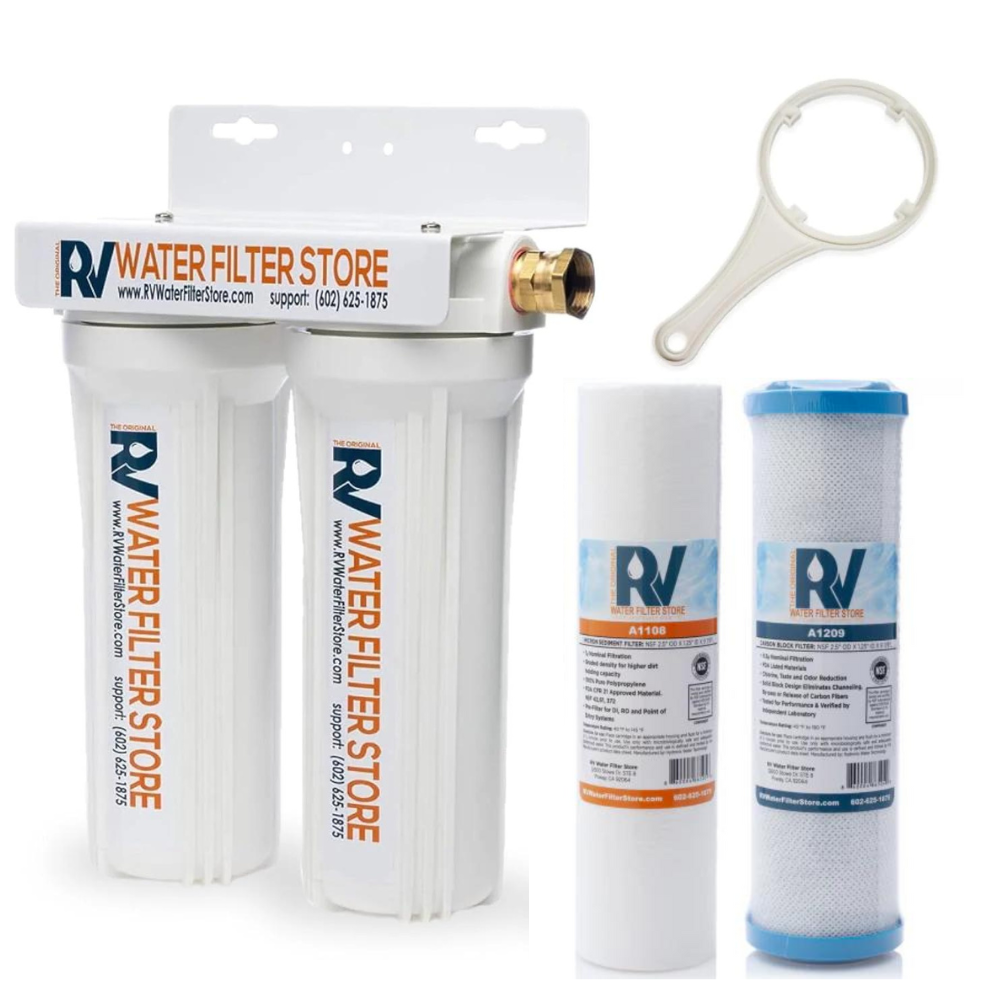
For an RV used in different regions, a dual-canister setup offers flexibility. One housing can handle sediment, while the second can hold a carbon cartridge appropriate for the water chemistry. However, the cartridge must still be selected for the disinfectant. A dual-canister system using ordinary chlorine-rated carbon does not automatically become a chloramine system.
Step 4: Select catalytic carbon for chloramine
Choose catalytic carbon with a stated chloramine-reduction claim. Compare the recommended flow rate with your actual use. If you need high flow for the entire RV, a larger system may provide better contact time than a small inline cartridge.
For drinking water, an under-sink system can provide a separate point-of-use treatment path. That allows you to prioritize contact time and performance for the water you drink and cook with, while using a whole-RV system for general water protection.
Step 5: Protect the filter from excessive pressure and flow
Use a potable-water hose and a properly adjusted pressure regulator. Follow the filter manufacturer’s instructions for regulator placement and maximum pressure.
A regulator controls pressure; it does not increase contact time. If flow is too high, close the faucet slightly or use a system designed for a higher flow rate.
Step 6: Flush new cartridges
Carbon cartridges may release fine carbon dust when first installed. Flush them according to the cartridge instructions until the water runs clear and any initial taste is gone.
Do not judge chloramine reduction solely by the first few minutes of flow. New media needs to be installed correctly, fully wetted, and operated within its rated conditions.
Step 7: Track usage and replace cartridges
Replacement timing depends on water quality and volume. A cartridge used by a full-time RVer at multiple campgrounds may exhaust faster than one used occasionally by a weekend camper.
Watch for:
- Reduced flow.
- Returning taste or odor.
- A cartridge that has reached its rated capacity.
- Visible sediment loading.
- Changes in campground water quality.
- An RO membrane or downstream filter that is losing performance.
The replacement filter cartridge collection includes carbon, sediment, specialty, and larger-format replacement options. Choose by cartridge type and system compatibility rather than by appearance alone. Keeping replacements on hand is particularly useful when traveling through areas with inconsistent water quality.
How to choose based on your travel style
Weekend campers
If you usually stay at municipal campgrounds that use free chlorine, a standard carbon filter with sediment protection may be a practical choice. Confirm the filter’s flow and capacity ratings, especially if you use water for showers and cooking.
If you frequently visit different states or campground networks, consider carrying a test kit or checking utility reports before deciding whether a chloramine-specific cartridge is necessary.
Full-time RVers
Full-time travelers are more likely to encounter several water profiles in a month. A staged whole-RV system with replaceable sediment and carbon cartridges provides adaptability.
If chloramine is common along your route, catalytic carbon and sufficient contact time deserve more attention than simply choosing the smallest or least restrictive cartridge.
RVers with under-sink RO
Treat chloramine as a membrane-protection issue. Use a compatible carbon prefilter that is specifically appropriate for chloramine, and follow the RO manufacturer’s replacement schedule.
Do not depend on the RO membrane alone to remove the disinfectant.
RVers with sensitive skin or hair
First consider hard water, since hardness minerals are a common cause of dry-feeling skin, mineral buildup, and poor soap performance. A water softener addresses hardness; a carbon filter addresses disinfectant taste and odor. They perform different jobs.
If the water source uses chloramine, a catalytic-carbon shower or point-of-use solution may be worth investigating, provided the product has a specific chloramine claim.
Common mistakes to avoid
Mistake 1: Assuming every carbon filter removes chloramine
Carbon is a broad category. Standard activated carbon and catalytic carbon are not identical in performance.
Mistake 2: Reading “chlorine” as “chlorine compounds”
A chlorine-reduction claim may refer specifically to free chlorine. Look for chloramine language when chloramine is the concern.
Mistake 3: Ignoring flow rate
A cartridge may perform well in a low-flow test but less effectively when pushed at the maximum rate of an RV hookup.
Mistake 4: Using hardness or TDS as a disinfectant test
Hardness and TDS meters tell you about minerals and dissolved material. They do not tell you whether the utility uses chlorine or chloramine.
Mistake 5: Relying on boiling or standing water
Free chlorine may dissipate more readily, but chloramine is persistent. Time and heat are not dependable substitutes for appropriate carbon media.
Mistake 6: Expecting a pressure regulator to filter water
A pressure regulator protects plumbing. It does not reduce disinfectants, sediment, or dissolved contaminants.
Final takeaway
The right carbon filter starts with identifying the disinfectant.
- Free chlorine: Standard activated carbon, GAC, or a carbon block is usually the appropriate starting point.
- Chloramine: Choose catalytic carbon with an explicit chloramine-reduction claim and enough contact time for the expected flow.
- Unknown campground water: Ask the utility, review the water report, and use a test designed for the specific disinfectant.
- RO system: Use carbon pretreatment before the membrane, especially when chloramine is present.
- Whole-RV protection: Use sediment filtration before carbon and replace cartridges according to capacity, flow, and water conditions.
The best RV filtration setup is not necessarily the most expensive or most restrictive. It is the one that matches the water source, disinfectant, flow requirements, and way you travel.
Frequently asked questions
Does a regular RV carbon filter remove chlorine?
Many standard activated-carbon RV filters are designed to reduce free chlorine, taste, and odor. Check the product’s performance claim, rated flow, and capacity. A chlorine claim does not automatically confirm chloramine reduction.
Does chloramine evaporate like chlorine?
No. Chloramine is substantially more stable than free chlorine and does not reliably disappear by standing or boiling. Catalytic carbon is generally preferred when chloramine reduction is needed.
Is carbon block better than GAC for chloramine?
Not automatically. Carbon block and GAC describe the filter format. For chloramine, the key issue is whether the media is catalytic and whether the system provides enough contact time at the operating flow rate.
Can KDF remove chloramine?
KDF may be useful as a supporting media in some systems, but do not assume it is a complete chloramine solution. Look for specific performance data and consider catalytic carbon when chloramine is the target.
Does NSF/ANSI 42 prove a filter removes chloramine?
No. NSF/ANSI 42 may cover chlorine taste and odor reduction, but you must verify whether the specific certification or test claim includes chloramine.
Will a water softener remove chlorine or chloramine?
A water softener is designed primarily to reduce hardness minerals such as calcium and magnesium. It should not be used as the primary treatment for chlorine or chloramine.
Should chloramine be removed throughout the RV?
That depends on your goals and equipment. Whole-RV treatment can reduce exposure at showers and fixtures, while point-of-use treatment focuses on drinking and cooking water. If you use an RO system, carbon pretreatment is important for membrane protection.
How often should I replace a carbon cartridge?
Follow the cartridge’s rated capacity and the manufacturer’s recommendations. Replace it sooner if flow drops, sediment loads the cartridge, or taste and odor return. Full-time RVers and travelers using challenging campground water may need more frequent changes.
Can I identify chloramine by taste or smell?
Not reliably. Taste and smell may suggest a disinfectant issue, but they cannot distinguish chlorine from chloramine with certainty. Ask the supplying utility or use an appropriate test method.


