

If hard water is leaving white deposits around your RV faucets, showerhead, water heater, or coffee maker, you have two common treatment options: a portable salt-regenerated water softener or a salt-free anti-scale cartridge.
Both can help reduce the problems associated with hard water, but they do not do the same job.
A portable ion-exchange softener removes calcium and magnesium from the water. An anti-scale cartridge leaves those minerals in the water but attempts to change how they behave, making them less likely to attach to plumbing and heating surfaces.
That distinction affects nearly every part of the ownership experience:
- How the water performs in showers and sinks
- Whether a hardness test shows improvement
- How much scale protection your RV receives
- Whether you need salt
- How often you replace a cartridge
- How much space and setup time the system requires
- Whether you get fewer water spots after washing or rinsing
The decisive answer is this: a portable ion-exchange softener handles hard water better when you want true soft water and the broadest reduction in scale-forming minerals. An anti-scale cartridge is the better fit when your priority is simpler, salt-free scale control and you are comfortable with the water remaining hard.
Why hard water creates problems inside an RV
Hard water contains dissolved calcium and magnesium. These minerals are naturally occurring and are not necessarily a sign that water is unsafe to drink. The concern for RV owners is what happens when hard water is heated, sprayed, evaporated, or allowed to dry on a surface.
When water is heated in an RV water heater, some of the dissolved minerals can precipitate and form deposits on the tank, heating element, or nearby plumbing. The risk depends on the source water, hardness, temperature, flow conditions, and how long the water remains in contact with surfaces.
Hard water can contribute to:
- Mineral buildup in water heater components
- Deposits around faucet aerators
- Restricted showerhead openings
- White spotting on dishes, windows, and exterior surfaces
- Scale on fixtures and plumbing connections
- Reduced soap lather
- A dry or filmy feeling after showering
- Mineral deposits inside appliances that heat water
The problem is often more noticeable in a small RV than in a house because RV plumbing has narrower passages, compact fixtures, and appliances that may be used with water from many different sources during the year.
Hardness also varies substantially from one campground or municipal supply to another. Water that seems fine at home may produce visible scale at the next campground. That is why testing the water at your current location is more useful than relying only on assumptions about a region.
RV Water Filter Store offers water hardness test products that can help you establish a baseline before deciding between softening and scale inhibition.

How a portable ion-exchange water softener works
A portable RV water softener uses a tank filled with cation-exchange resin. As hard water passes through the resin, calcium and magnesium ions attach to the resin beads. Sodium ions are released into the water in exchange.
In simplified terms:
- Hard water enters the softener.
- Calcium and magnesium are captured by the resin.
- Sodium takes their place in the water.
- The treated water exits with much less calcium and magnesium.
This is true softening because the water’s hardness has been reduced. The water still contains dissolved material, and a softener is not the same as a reverse osmosis system. However, the specific minerals most responsible for conventional hard-water scale are substantially reduced.
What happens during regeneration?
The resin eventually becomes loaded with calcium and magnesium. It then needs to be regenerated with a concentrated salt solution.
During regeneration:
- Salt is dissolved in water to create brine.
- The brine passes through the resin.
- Sodium displaces the calcium and magnesium collected by the resin.
- The spent brine and displaced minerals are flushed away.
- The resin is rinsed and returned to service.
The timing depends on the softener’s grain capacity, the hardness of the incoming water, and how much water your household uses. A softener used by two people for showers and dishes may need regeneration less often than one supporting a family, laundry, frequent tank fills, and long stays in a very hard-water area.
Regeneration is not a defect or an unnecessary complication. It is the normal maintenance process that restores the resin’s ability to exchange ions. The trade-off is that you need access to salt, a place to perform the process, and enough time to rinse the unit properly.
What does softened water actually do?
Because calcium and magnesium are removed, softened water generally:
- Produces a lower hardness reading
- Creates less scale in water heaters and plumbing
- Improves soap lather
- Reduces mineral residue on fixtures
- Helps reduce water spotting
- Feels different during bathing for many users
- Reduces the amount of hardness minerals entering RV appliances
Softening does not guarantee a perfectly spot-free rinse. Water can contain other dissolved solids, and spots can also result from water drying on a surface, soap residue, dust, or minerals that are not removed by the softener.
Ion exchange also does not remove every contaminant. A softener should usually be paired with appropriate sediment and carbon filtration when the goal includes better taste, odor, chlorine reduction, or protection from suspended particles.
What about sodium?
A portable softener adds a small amount of sodium because sodium replaces calcium and magnesium in the ion-exchange process. The amount depends on the hardness of the source water and the volume treated.
This matters if someone in the RV follows a medically prescribed low-sodium diet. In that situation, do not assume softened water is appropriate for drinking or cooking without discussing the issue with a qualified medical professional. Some RV owners use softened water for showers and general plumbing while routing drinking water through a separate treatment system.
A softener’s total dissolved solids reading may remain similar or even increase slightly because the system exchanges one group of dissolved ions for another. A TDS meter therefore cannot tell you whether a softener is working. Use a hardness test for hardness.
How an anti-scale cartridge works
An anti-scale cartridge is a conditioner, not a conventional softener. It is designed to reduce the tendency of calcium and magnesium to form hard, adherent deposits while leaving much of the mineral content in the water.
Different anti-scale cartridges use different media. Common approaches include:
- Template-assisted crystallization, often called TAC
- Polyphosphate or phosphate-based scale inhibition
- Specialty media that changes the way minerals precipitate or interact with surfaces
- Combination cartridges that pair scale-control media with carbon filtration
The mechanism depends on the specific cartridge. A TAC-style medium encourages dissolved minerals to form microscopic crystals that are less likely to attach to plumbing surfaces. Polyphosphate-based media can surround or complex with hardness minerals, reducing their tendency to form conventional deposits under certain conditions.
The important limitation is that these treatments generally do not remove calcium and magnesium from the water.
The water may still test as hard. It may still feel like hard water. Soap may still lather less readily than it does with softened water. Water spots may still appear after a rinse because the dissolved minerals remain present.
The goal is primarily to reduce the amount of hard scale that adheres to surfaces, especially in applications where scale prevention is more important than changing the water’s feel or hardness measurement.
RV Water Filter Store’s specialty cartridge collection includes cartridges designed for specific water-quality concerns, including scale-control options. Always check the individual cartridge specifications, flow requirements, media type, and replacement instructions before choosing one.

Portable softener vs. anti-scale cartridge: side-by-side comparison
| Consideration | Portable ion-exchange water softener | Anti-scale cartridge |
|---|---|---|
| Primary process | Removes calcium and magnesium through ion exchange | Changes how minerals behave so they are less likely to form adherent scale |
| Does it truly soften water? | Yes | No, in most cases |
| Effect on hardness test | Hardness should drop when the unit is operating correctly | Hardness usually remains close to the incoming level |
| Effect on calcium and magnesium | Removes them from the water and replaces them primarily with sodium | Leaves them in the water, although some may be conditioned or complexed |
| Scale protection | Broad and direct because the main scale-forming minerals are reduced | Scale inhibition depends on media, water chemistry, flow, temperature, and sizing |
| Effect on soap lather | Usually improves | Usually little or no improvement |
| Effect on water feel | Often feels smoother or less “hard” | Usually feels like the original water |
| Effect on water spots | Can reduce mineral spotting, but does not guarantee spot-free rinsing | May reduce adherent scale but usually does not eliminate spots |
| Sodium addition | Yes, because sodium replaces calcium and magnesium | Usually no sodium added |
| TDS reading | May stay similar or rise slightly | Usually stays similar; polyphosphate media may add dissolved phosphate |
| Maintenance | Periodic salt regeneration, flushing, and cleaning | Cartridge replacement according to media life and usage |
| Salt storage | Required | Not required |
| Setup | Requires a tank, hoses, fittings, and regeneration space | Usually fits into a standard cartridge housing or inline configuration |
| Flow and pressure | Depends on tank size, resin bed, hose size, and flow rate | Depends on cartridge design, media density, housing, and sediment loading |
| Winter storage | Drain and protect from freezing; follow the unit’s storage instructions | Drain and protect the housing and cartridge from freezing; follow cartridge instructions |
| Best for | True soft water, heavy hardness, long-term use, and maximum reduction of scale-forming minerals | Lower-maintenance scale control where hard water can remain acceptable |
Performance differences you will notice in the RV
Water heater protection
A portable softener has the stronger direct effect because it removes much of the calcium and magnesium before the water enters the RV. That reduces the mineral load available to form deposits when the water is heated.
An anti-scale cartridge may help reduce the amount of adherent scale, but the result depends on the cartridge media and water conditions. The water still contains hardness minerals, so it is better described as scale control rather than mineral removal.
If the water heater is your main concern and you do not care about water feel, an anti-scale cartridge may be a reasonable lower-maintenance option. If you want the most comprehensive reduction in hardness throughout the RV, use a softener.
Faucets and showerheads
A softener can reduce the white mineral residue that collects around aerators and shower openings. It may also make showering and handwashing feel different because soap interacts more efficiently with softened water.
An anti-scale cartridge may reduce hard, bonded deposits over time, but it will not make the water behave like soft water. You may still see spots, and you should not expect the same improvement in lather.
Appliances
Coffee makers, ice makers, washing machines, and other water-using appliances can be affected by hard water. A softener reduces the calcium and magnesium entering the appliance. An anti-scale cartridge attempts to reduce deposit formation without removing the minerals.
For an appliance with a heating element, scale inhibition may be useful. For an appliance where taste and water chemistry matter, you may also need carbon filtration or a separate drinking-water system.
Spot-free rinsing
A softener generally performs better for reducing mineral spots, but “spot-free” is too strong a promise for either system. Softened water still contains sodium and other dissolved material. Anti-scale media leaves hardness minerals in the water, so it is not the first choice when the main objective is fewer spots on dark vehicles, windows, dishes, or polished fixtures.
Rinsing technique also matters. Allowing water to dry on a surface will usually create more visible residue than drying or wiping promptly.
Maintenance, cost, space, and convenience
Regeneration versus cartridge replacement
The biggest maintenance difference is the type of ongoing work involved.
A portable softener requires:
- Salt
- Periodic regeneration
- A suitable place to discharge the rinse water
- Fresh-water rinsing after brining
- Protection from freezing
- Occasional inspection of fittings, hoses, and connections
The frequency is not fixed. Regenerate based on your source-water hardness, water usage, and the manufacturer’s instructions rather than following a calendar rule that ignores conditions.
An anti-scale cartridge does not need salt regeneration. Instead, you replace the cartridge when the media is exhausted or when the manufacturer’s service interval has been reached. Cartridge life can vary with hardness, flow, water temperature, and total gallons treated.
A cartridge is simpler to use, but “maintenance-free” is not accurate. It still needs monitoring and replacement. An exhausted cartridge cannot provide the same scale-control performance as a fresh one.
Space and weight
A portable softener usually occupies more space than a single cartridge. You need room for the tank, hose connections, and salt. The unit may also be heavier when wet.
An anti-scale cartridge can be more compact, especially when installed in an existing filter housing. That can be important for a small travel trailer, a crowded storage compartment, or an RV owner who does not want another tank outside the coach.
The space advantage does not automatically mean lower total cost. Compare the initial equipment, cartridge replacement schedule, salt usage, fittings, and any additional housing required.
Flow rate and pressure drop
Neither technology has one universal flow rate or pressure-drop result. Performance depends on:
- Tank or cartridge size
- Inlet and outlet fittings
- Hose diameter
- Media depth and density
- Water temperature
- Incoming pressure
- Sediment loading
- The manufacturer’s rated service flow
A portable softener can provide good flow when correctly sized, but a compact resin tank may create restriction if pushed beyond its intended rate. An anti-scale cartridge may have a lower or higher pressure drop depending on its media and housing design.
A clogged sediment filter can create more pressure loss than the softener or anti-scale cartridge itself. This is one reason filtration stages should be maintained rather than judging the treatment device based on a system with an overloaded prefilter.
Winter storage and travel between campgrounds
Freezing can damage housings, tanks, fittings, and media. Before winter storage, disconnect the system, drain as much water as possible, and protect it from freezing temperatures.
For a portable softener, follow the manufacturer’s instructions about keeping the resin wet, storing the tank upright, and preparing it after a long period out of service. Do not assume that leaving trapped water inside is harmless.
For a cartridge system, remove and drain the housing as directed. Some cartridges can be stored in place only under specific conditions, while others should be removed, sealed, or replaced before the next trip.
When moving frequently, protect hose ends from dirt and keep quick connects capped. A pressure regulator at the campground spigot can also help protect RV plumbing from excessive supply pressure. The regulator should be installed according to the intended system layout, and the filter, softener, and hose connections should be checked for leaks whenever you change sites.
How each option pairs with sediment and carbon filtration
A softener or anti-scale cartridge should not be expected to perform every water-treatment job.
Sediment filtration
Sediment filtration removes suspended particles such as sand, rust, silt, and visible debris. Placing sediment filtration before a softener or specialty cartridge can help protect the treatment media and reduce premature clogging.
A practical external setup may include:
- Campground spigot
- Pressure regulator
- Sediment filtration
- Carbon filtration, when needed
- Water softener or anti-scale treatment
- RV city-water connection
The best order can vary by product design, so follow the instructions for the specific system.
Carbon filtration
Carbon filtration is used primarily for taste, odor, chlorine, and some organic compounds. It does not soften water and should not be used as a substitute for hardness treatment.
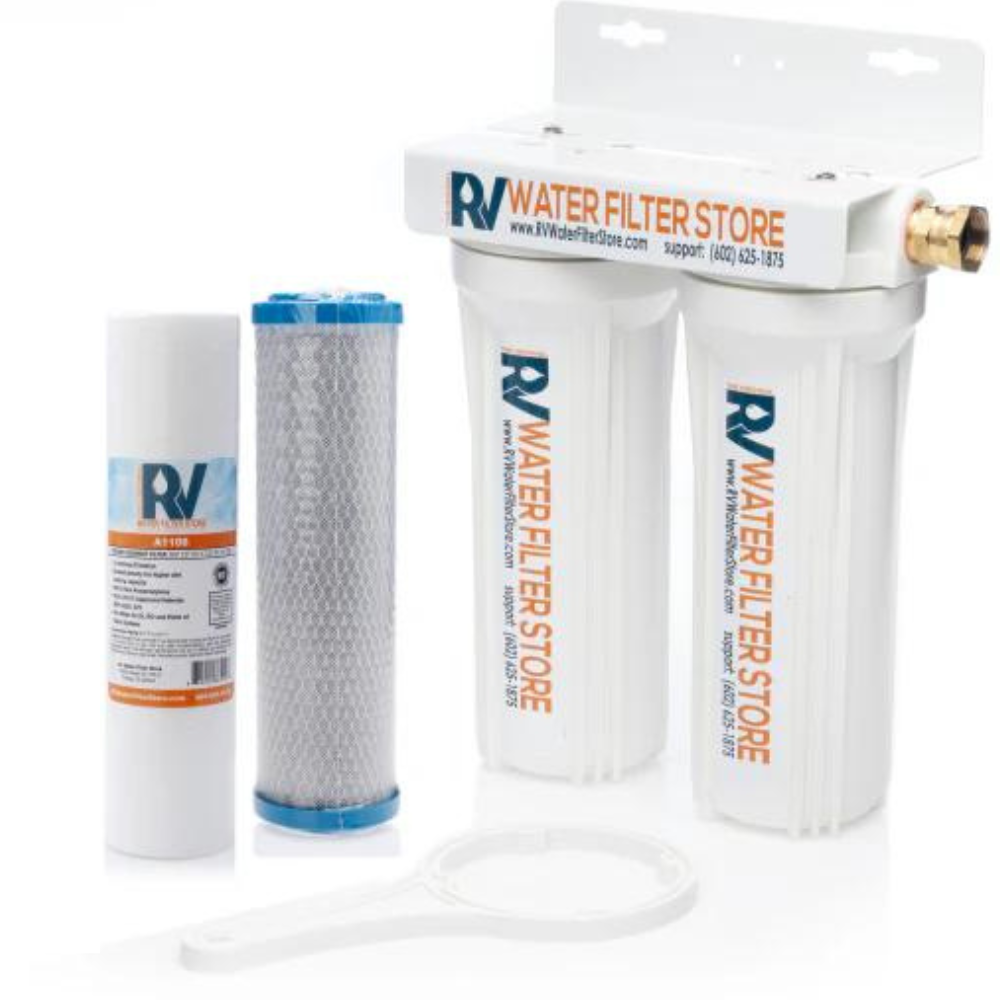
RV Water Filter Store’s whole-RV filtration systems can be configured around different water-quality goals. A system that combines sediment and carbon stages may improve general water quality, while a softener or specialty anti-scale cartridge addresses the separate issue of hardness and scale.
Some cartridges combine carbon with scale-control media. That can be convenient, but remember that a combination cartridge has multiple jobs and must be replaced according to its limiting capacity and the manufacturer’s instructions.
Which option fits your travel style?
| Travel style or water condition | Better starting point | Why |
|---|---|---|
| Weekend traveler with moderate hard water | Anti-scale cartridge if simplicity is the priority; softener if better shower feel matters | Short trips may not justify carrying salt and regenerating, but true soft water is still the stronger treatment |
| Full-time RVer | Portable ion-exchange softener | Frequent water use makes the benefits of lower hardness, improved lather, and broader scale reduction more noticeable |
| Long-term renter of an RV pad | Portable ion-exchange softener | A stationary or semi-permanent setup makes regeneration easier and provides consistent treatment over a longer stay |
| Traveler who moves every day or two | Anti-scale cartridge or compact softener depending water severity | Cartridge convenience may outweigh regeneration work, but very hard water can justify the extra effort of a softener |
| Extremely hard-water region | Portable ion-exchange softener | Removing calcium and magnesium is the more decisive approach when scale and spotting are severe |
| Limited storage space | Anti-scale cartridge | A cartridge housing usually takes less room than a portable tank and salt supplies |
| Low-sodium concern | Anti-scale cartridge, with appropriate product review | Anti-scale systems generally do not add sodium, but verify the exact media and intended use |
| Main concern is shower comfort and soap lather | Portable ion-exchange softener | Lower hardness changes how soap behaves; scale inhibition alone usually does not |
| Main concern is reducing heater deposits without salt | Anti-scale cartridge | It can provide a lower-maintenance scale-control approach, although results depend on water conditions |
| Frequent boondocking with limited access to replacement cartridges | Portable softener if salt and water for regeneration are available | Table salt is widely available, but regeneration still requires proper water handling |
| Drinking water is treated separately | Either option for general plumbing | A softener or anti-scale cartridge can serve the RV plumbing while a separate drinking-water system addresses taste or specific contaminants |
A practical decision process
Use this sequence before buying:
1. Test the source water
Test the water at the campground or supply point you expect to use. A hardness test is more informative than a TDS reading for this decision. TDS tells you that dissolved material is present; it does not identify how much of that material is calcium and magnesium.
2. Decide whether you need soft water or scale control
Choose a portable softener when you want:
- Lower measured hardness
- Better soap lather
- Less mineral residue
- Improved bathing comfort
- Reduced calcium and magnesium throughout the RV
- The strongest general approach to hard-water scale
Consider an anti-scale cartridge when you want:
- No salt
- Less maintenance
- A compact setup
- Reduced scale adhesion rather than mineral removal
- Water that can remain hard without affecting your routine
3. Account for your actual routine
A full-time RVer who showers, cooks, washes dishes, and fills an onboard tank every day will experience the difference between the two approaches more clearly than someone who visits a campground for one weekend each month.
Likewise, the best choice for a small trailer may be different from the best choice for a motorhome with ample exterior storage.
4. Plan the complete filtration setup
Hardness treatment is only one part of RV water quality. Consider sediment, chlorine, taste, odor, pressure regulation, hose quality, and drinking-water needs separately.
A softener does not replace carbon filtration. An anti-scale cartridge does not replace sediment filtration. A pressure regulator does not filter or soften water. Each component has a different job.
Final recommendation
If the question is strictly, “Which handles RV hard water better?” the answer is a portable ion-exchange water softener.
It is the stronger choice when you want to remove calcium and magnesium, lower the hardness reading, improve soap performance, reduce mineral spotting, and provide broad protection for water heaters, fixtures, and appliances. Its disadvantages are the need for salt, regeneration, storage space, and attention to sodium.
An anti-scale cartridge is better described as a simpler scale-control option. It can be a smart choice for weekend travelers, tight storage areas, renters who want minimal setup, or anyone who wants to avoid salt. It may reduce the tendency for scale to adhere, but it does not usually turn hard water into soft water. Hardness, water feel, soap behavior, and mineral spotting may remain much closer to the original condition.
For extremely hard water or full-time use, choose the portable softener unless there is a specific reason not to. For moderate hard water and low-maintenance travel, an appropriately selected anti-scale cartridge may be enough.
Either way, start with a water test, protect the treatment device with suitable sediment filtration, and follow the product’s rated flow, replacement, regeneration, and storage instructions.


