

The price on the box is only the starting point. The more useful question is: What will this RV water filtration setup cost me per year based on how I travel?
A weekend camper who spends 20 nights on the road does not use filters the same way as a full-time RVer with water running every day. A snowbird may spend four to six months connected to campground water, while a boondocker may fill a fresh tank periodically and use far fewer gallons through an outside filter.
That difference changes cartridge intervals, softener regeneration, accessory wear, and cost per gallon.
This article gives you a practical way to calculate your own number without relying on broad published averages. Use your system’s actual cartridge ratings, current prices, water conditions, and measured usage. The examples below are clearly labeled fictional budgeting exercises, not universal estimates or product quotes.
Why RVers underestimate annual filtration cost
Most people compare the purchase price of one system with the purchase price of another. That is useful, but incomplete.
A lower-priced setup may require more frequent cartridge changes. A system with a higher initial price may use larger-capacity cartridges or a refill kit that lasts longer in your water conditions. A cheap inline filter may appear economical until you replace one for every trip. A portable softener may add salt costs but help reduce scale-related maintenance.
The purchase price answers:
“What will I spend to get started?”
Annual cost answers:
“What will I spend to keep treating water during the way I actually travel?”
A useful budget should include:
- The whole-RV canister system or inline setup
- Replacement sediment, carbon, specialty, or virus-rated cartridges
- A sediment pre-filter, if used
- Inline filters, if used in addition to a canister system
- A portable water softener and regeneration salt
- Water test kits
- A pressure regulator
- A potable drinking-water hose
- O-rings, washers, quick connects, and other small fittings
- The annualized share of one-time equipment costs
- Any applicable shipping or subscription charges
Not every RVer needs every category. The goal is to count the categories that apply to your setup rather than assume that every filtration system has the same ownership cost.
Start with the equipment you already have
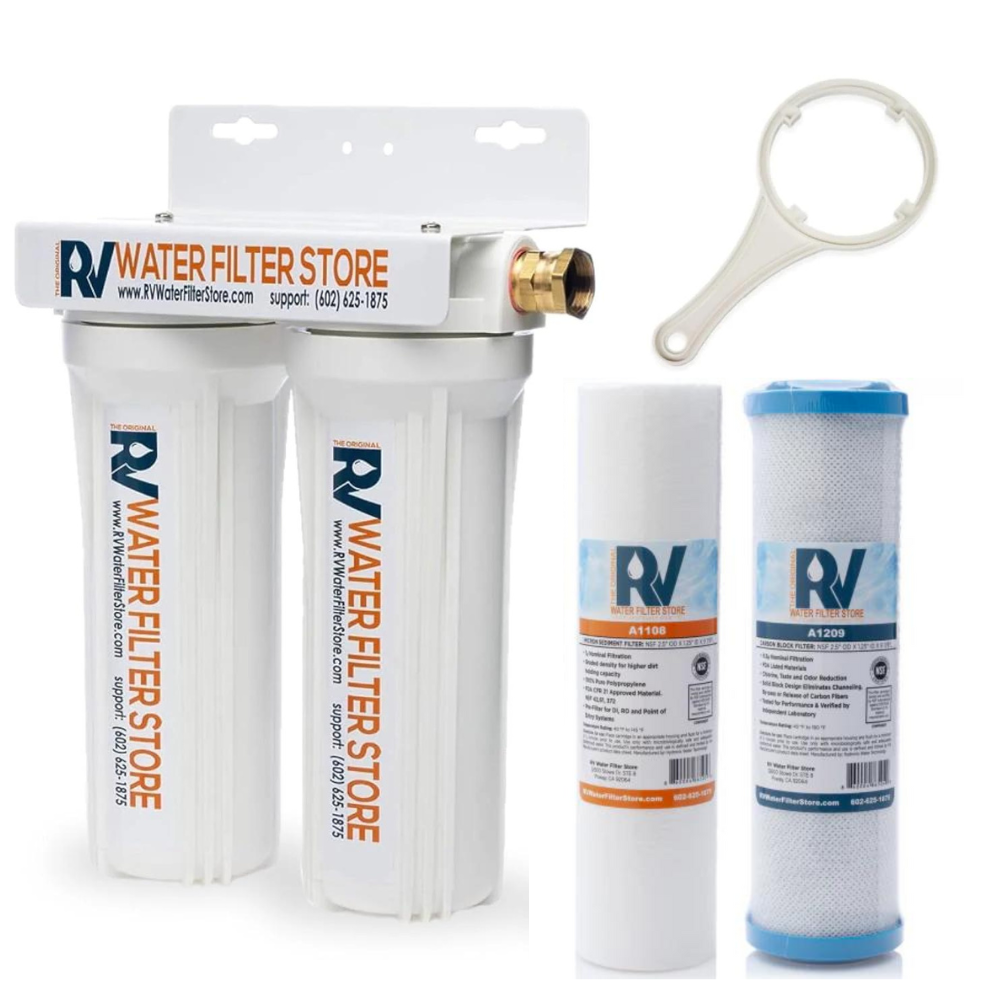
If you are building a new setup, begin with the current price of the system you are considering. RV Water Filter Store offers whole-RV systems in different configurations, including dual- and triple-canister options. You can compare current system choices in the whole-RV water filtration systems collection.
If you already own a system, do not automatically include the original purchase price in this year’s cash budget. Instead, decide whether you want to calculate:
- This year’s cash cost, or
- A longer-term annual ownership cost
For a longer-term estimate, divide the equipment price by the number of years you expect to use it:
Annualized equipment cost = equipment price ÷ planned ownership years
For example, if you choose a five-year planning period, a fictional $200 system contributes $40 per year to the annualized budget. That does not mean the system will fail after five years. It simply spreads the original purchase across a planning period so you can compare ownership costs more fairly.
You can also annualize accessories the same way:
- Pressure regulator
- Potable hose
- Mounting hardware
- Quick connects
- Hoses and adapters
- Test equipment
For a first-year cash budget, count the full purchase price instead. For later-year comparisons, use your chosen annualization period.
Cost categories to include
| Cost category | How to calculate it | Why it matters |
|---|---|---|
| Whole-RV canister system | Purchase price, or price divided by planned ownership years | The initial equipment cost is easy to see but often left out of long-term comparisons |
| Sediment cartridges | Price multiplied by the number used per year | Sediment often clogs before carbon and may need the most frequent replacement |
| Carbon cartridges | Price multiplied by actual annual cartridge count | Carbon performance depends on the cartridge rating, water quality, and time limit |
| Specialty cartridges | Price multiplied by annual replacement count | Iron, heavy-metal, anti-scale, or other specialty media may have different intervals |
| Inline filter | Price multiplied by actual number used | Some RVers use an inline filter alone; others use it as an additional stage |
| Portable softener | Annualized equipment price plus salt and maintenance | Softening is separate from filtration and adds a consumable salt cost |
| Water test kit | Test kit price divided across expected uses or years | Testing can help you make decisions based on your source water rather than guesswork |
| Pressure regulator | Annualized replacement or purchase cost | Protects RV plumbing from excessive campground pressure |
| Potable drinking-water hose | Annualized replacement cost | Hoses wear, crack, or become difficult to clean over time |
| O-rings and fittings | Actual purchases or a small maintenance allowance | Small leaks can interrupt a trip and may damage connections |
| Shipping or subscription charges | Add the actual amount shown at checkout | A discounted filter price is not the same as the final delivered cost |
The most important category is usually replacement cartridges. That is where the cost-per-gallon calculation becomes useful.
How to calculate cartridge cost honestly
Do not begin with a generic statement such as “replace filters every three months.” That may be appropriate for one system and unnecessary for another.
Instead, record four numbers for each cartridge:
- Cartridge price
- Manufacturer-rated capacity in gallons
- Manufacturer’s maximum time interval
- Your actual annual gallons or usage
Then use the earlier of the capacity limit or the time limit.
Step 1: Estimate annual gallons
The most accurate method is to measure your usage. Depending on your equipment, you may be able to use:
- A water meter at the campground connection
- A known fresh-tank fill volume
- A hose-end flow meter
- A household water meter when connected at home
- Repeated tank-fill records
- A reasonable log of showers, dishwashing, laundry, and drinking water
If you do not have a meter, create a conservative estimate from your own routine. Avoid treating an online average as a fact about your RV. Two similarly sized motorhomes can use very different amounts of water.
For a connected-water setup:
Annual filtered gallons = gallons used through the filter during the year
For a boondocking setup:
Annual filtered gallons = gallons passing through the filter when you fill the tank or collect drinking water
If you fill a tank through an outside filter and then use that water inside the RV, count the gallons filtered during the fill. Do not count the same gallons again when they leave the tank.
Step 2: Calculate capacity-based cartridge use
Use this formula:
Capacity-based replacements = annual filtered gallons ÷ rated cartridge capacity
Round up to a whole cartridge.
If a fictional cartridge is rated for 1,000 gallons and your measured annual usage is 1,700 gallons, capacity alone indicates two cartridges. If the manufacturer also says to replace it every six months, compare that time limit with your usage and use whichever requires more frequent replacement.
Step 3: Apply the time limit
A cartridge can reach its time limit before reaching its gallon rating. Storage conditions, source-water quality, seasonal use, and the manufacturer’s instructions all matter.
A practical formula is:
Annual cartridges = the greater of capacity-based replacements or time-based replacements
For example, if a cartridge is rated for two replacements per year by time but your gallon calculation indicates only one, budget for two unless the manufacturer gives different instructions.
Also replace earlier if you see signs such as:
- Noticeably reduced flow
- A sudden pressure drop across the filter
- Sediment breakthrough
- Returning chlorine taste or odor
- A change in water appearance
- A cartridge that is visibly loaded with material
- A manufacturer warning based on specific source-water conditions
Capacity ratings are not guarantees that a cartridge will perform identically at every campground. Dirty source water can load a sediment cartridge quickly. Chlorine concentration and other water conditions can affect carbon performance. Use the rating as a planning tool, then adjust based on observation and the manufacturer’s guidance.
Sediment pre-filters can lower total annual cost
A sediment pre-filter is often the least expensive cartridge in the setup, but it can have an important financial job: protecting the more expensive stages downstream.
Sediment may come from:
- Campground plumbing
- Well water
- Aging municipal lines
- Construction near a campground
- Rust or mineral particles
- A dirty hose bib or connection
When sediment reaches the main carbon block or specialty cartridge, it can restrict flow and use up the cartridge’s practical life before its rated capacity is reached.
A sacrificial sediment cartridge gives you a less expensive stage to monitor and replace. If it clogs, replacing it may cost less than replacing a specialty cartridge that was forced to handle the same load.
This does not mean every RVer should use the same micron rating or change schedule. A very fine sediment cartridge may restrict flow sooner in dirty water. A coarser pre-filter may be more appropriate as the first stage, depending on your system and the manufacturer’s design.
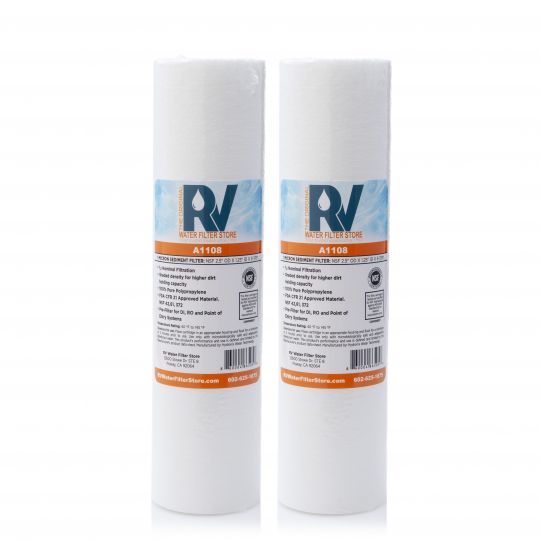
When comparing cartridges in the replacement filter cartridge collection, match the cartridge type, size, micron rating, and intended position in your system. A cartridge that physically fits is not automatically the correct replacement.
Inline filters: count them separately
Some RVers use a disposable inline filter connected directly to the potable-water hose. Others use an inline filter before a larger whole-RV canister system. Some use an inline drinking-water filter only at a dedicated faucet.
Count each use separately.
Annual inline-filter cost = price per inline filter × number used per year
The number used should come from your real travel pattern and the manufacturer’s replacement direction. If you install one filter at every campground, your cost is tied to campground changes. If you leave one connected for a longer period, the time and gallon limits still apply.
Do not automatically add an inline filter to a whole-RV system if it does not serve a purpose in your setup. Redundant filtration can increase cost and reduce flow without necessarily improving the treatment result. Choose stages based on the source-water problem you are trying to address.
Water softener cost is separate from filtration cost
A water softener and a water filter do different jobs.
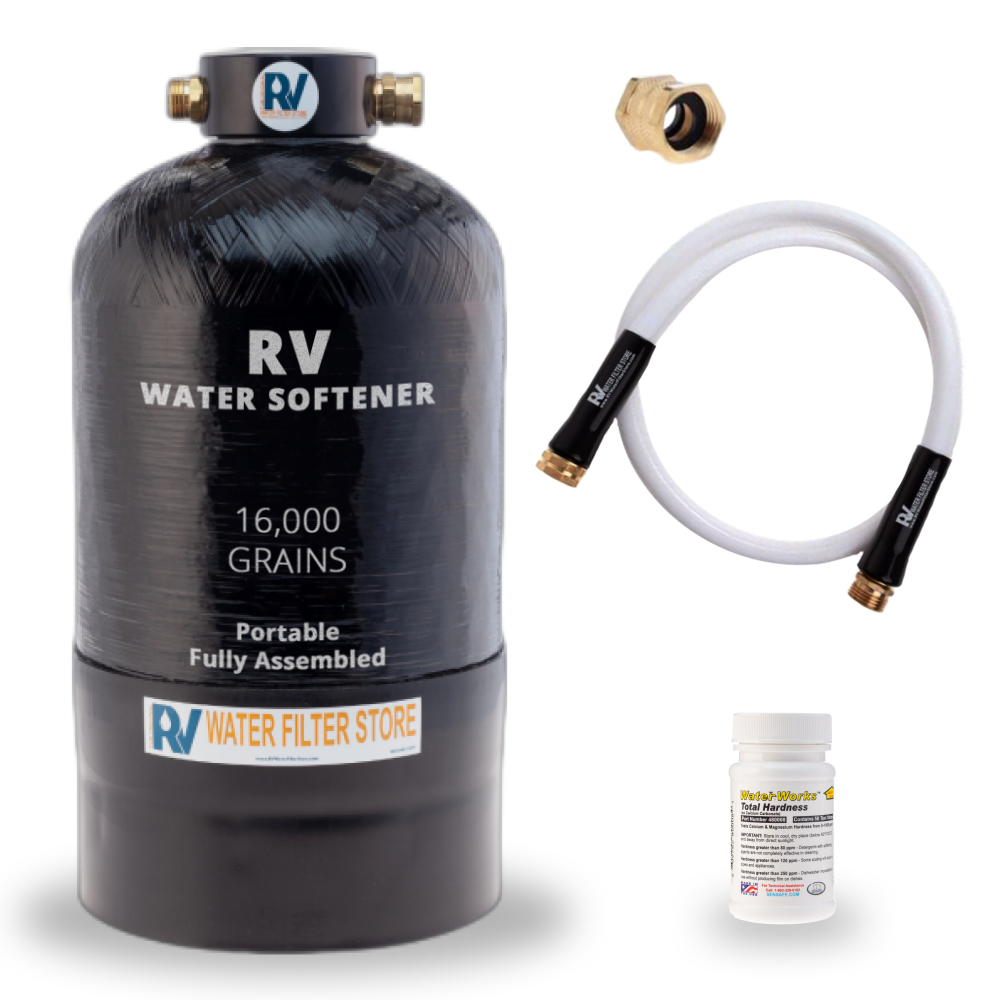
Filtration may target sediment, chlorine, taste, odor, or specific contaminants depending on the cartridge. A portable softener uses resin to reduce hardness minerals such as calcium and magnesium. It requires regeneration, usually with salt, according to the specific softener’s instructions.
A softener budget should include:
- Initial softener purchase
- Salt used for regeneration
- Occasional cleaning or maintenance supplies
- Replacement resin or refill components when needed
- Hoses, adapters, and connectors
- Any water testing used to monitor hardness
Do not invent a universal salt schedule. Regeneration frequency depends on the softener’s capacity, source-water hardness, gallons used, and the manufacturer’s procedure.
Track your own salt use:
Annual salt cost = salt used per regeneration × regenerations per year × cost per unit of salt
A larger portable softener may cost more initially but require regeneration less often in a particular travel pattern. A smaller unit may be easier to store but need more frequent regeneration. Compare the actual capacity and your measured hardness rather than choosing solely by purchase price.
You can compare current portable softener options in the RV water softeners collection.
How travel style changes the math
Weekend warrior: 20–30 camping nights per year
A weekend RVer may use relatively few gallons, but the calendar can still matter. If the manufacturer specifies a replacement interval based on time, a cartridge may need replacement even if it has not reached its gallon rating.
For this travel style, start with:
- Number of camping nights
- Number of trips
- Whether water stays connected between trips
- Gallons used per trip
- Whether the system is drained and stored
- Whether an inline filter is changed every trip
- Whether a cartridge is opened and installed only for the season
The biggest mistake is assuming that low annual gallons always mean no replacement cost. Time limits, storage practices, and the condition of the cartridge still matter.
A weekend RVer may be able to reduce cost by avoiding unnecessary duplicate filtration stages, using a correctly matched sediment pre-filter, and buying only the number of cartridges supported by the manufacturer’s schedule.
Snowbird: four to six months on the road
Snowbirds typically have a concentrated season of water use. Their annual calculation should separate active travel months from storage months.
Track:
- Total days connected
- Number of campground moves
- Gallons used during the season
- Water conditions at each major stop
- Cartridge changes made before departure, during travel, and before storage
- Softener regenerations and salt consumption
A snowbird may use fewer annual gallons than a full-timer but still reach a calendar replacement interval during the active season. Changing source water frequently can also make the sediment stage less predictable.
Budget for enough replacement cartridges to handle the season, but do not automatically buy a full-time quantity. Use last season’s records as the starting point.
Full-time RVer: water used every day
A full-timer generally has the clearest case for tracking cost per gallon. Water passes through the system continuously, so gallon capacity and flow changes become meaningful indicators.
Track:
- Monthly gallons
- Cartridge installation dates
- Cartridge removal dates
- Water source and campground location
- Pressure before and after filtration, if measured
- Sediment cartridge appearance
- Carbon taste and odor performance
- Softener regeneration frequency
- Salt use
A full-timer may need more frequent sediment changes than carbon changes. Replacing every stage on the same date can be convenient, but it may not be the lowest-cost approach if the stages have different ratings and conditions. Follow the system design and manufacturer instructions rather than changing cartridges solely because another stage is due.
Boondocker using fresh-tank water
A boondocker’s cost depends on where the filtration occurs.
If you filter water into the fresh tank, count the gallons treated during each tank fill. If you use a separate drinking-water filter at the faucet, count the gallons that pass through that drinking-water stage. If you fill from a known safe source without using an RV filter, the filter may not see those gallons at all.
Boondockers should also consider:
- How long filtered water is stored
- Whether the tank and lines are sanitized
- Whether water is filtered before or after storage
- Whether the pump creates a different flow pattern
- Whether the filter is used only for drinking and cooking
- Whether a softener is practical for the available water source
Do not use the RV’s tank capacity as annual consumption. Tank size tells you how much can be stored, not how much you use in a year.
A simple worksheet for your travel style
Fill in the following figures from your records and product documentation:
| Item | Your number |
|---|---|
| Camping or travel days per year | ___ |
| Gallons filtered per trip, month, or tank fill | ___ |
| Total annual filtered gallons | ___ |
| Sediment cartridge price | $___ |
| Sediment cartridge gallon rating | ___ gallons |
| Sediment cartridge time limit | ___ |
| Carbon cartridge price | $___ |
| Carbon cartridge gallon rating | ___ gallons |
| Carbon cartridge time limit | ___ |
| Specialty cartridge price | $___ |
| Specialty cartridge rating and time limit | ___ |
| Inline filters used per year | ___ |
| Salt cost per regeneration | $___ |
| Regenerations per year | ___ |
| Test kits used per year | ___ |
| Annualized equipment and accessory cost | $___ |
For each cartridge:
Annual cartridge cost = number of cartridges needed × price per cartridge
Then add the other categories:
Annual water-treatment cost = cartridges + inline filters + salt + testing + annualized equipment + maintenance parts
Finally:
Cost per filtered gallon = annual water-treatment cost ÷ annual filtered gallons
That final number is useful only if the gallons are measured or estimated honestly. A small annual cost divided by an unrealistically large gallon estimate will make the setup look cheaper than it is.
Worked example 1: fictional weekend RVer
The following is a fictional example for comparison. It is not a recommendation, average, or store quote.
Suppose a weekend RVer camps 24 nights per year and estimates that 300 gallons pass through a dual-canister system. The owner uses a sediment cartridge and a carbon cartridge in the system.
Fictional planning inputs:
- System purchase: $120
- Five-year planning period: $120 ÷ 5 = $24 annualized
- Sediment cartridge: $12 each
- Carbon cartridge: $46 each
- One complete refill set used per year: $58 total
- Water test supplies: $10 per year
- O-rings and small fittings: $5 per year
- No inline filter
- No portable softener
- Annual filtered water: 300 gallons
Annual budget:
| Category | Fictional annual cost |
|---|---|
| Annualized system cost | $24 |
| One refill set | $58 |
| Water testing | $10 |
| O-rings and fittings | $5 |
| Estimated annual cost | $97 |
Cost per gallon:
$97 ÷ 300 gallons = approximately $0.32 per filtered gallon
The result is driven more by the refill set and low annual gallon volume than by the equipment itself. If the owner instead used an inline filter for every trip, that separate cost would need to be added. If the manufacturer’s time limit required more frequent replacement, the refill count would also change.
Worked example 2: fictional full-time RVer
Now consider a fictional full-time RVer who filters 3,000 gallons per year through a dual-canister system and also uses a portable softener.
Fictional planning inputs:
- System purchase: $250
- Five-year planning period: $250 ÷ 5 = $50 annualized
- Sediment cartridges: four per year at $12 each = $48
- Carbon cartridges: two per year at $35 each = $70
- Softener salt: $60 per year
- Water testing: $20 per year
- Replacement fittings and O-rings: $10 per year
- No extra inline filter
- Annual filtered water: 3,000 gallons
Annual budget:
| Category | Fictional annual cost |
|---|---|
| Annualized system cost | $50 |
| Sediment cartridges | $48 |
| Carbon cartridges | $70 |
| Softener salt | $60 |
| Water testing | $20 |
| Fittings and O-rings | $10 |
| Estimated annual cost | $258 |
Cost per gallon:
$258 ÷ 3,000 gallons = approximately $0.086 per filtered gallon
The full-time RVer spends more in total but less per filtered gallon because the equipment and maintenance costs are spread across higher usage. That does not mean the full-time setup is automatically the better choice for a weekend traveler. It simply demonstrates why travel pattern changes the math.
Substitute your own cartridge prices, rated capacities, gallons, salt use, and replacement schedule.
How Subscribe & Save changes the annual number
A replacement subscription can make annual budgeting easier and may change the delivered cartridge cost. The current Subscribe & Save program lists benefits such as free shipping, a discounted price, the ability to change, skip, or cancel, and the ability to update a shipping address while traveling. Review the current terms and product price in the Subscribe & Save replacement filter collection.
To calculate the effect, compare:
One-time purchase cost × annual cartridge quantity
with:
Subscription price × annual cartridge quantity + any applicable delivery charges
Do not subscribe to more cartridges than your system and travel pattern require. A subscription saves money only when the delivered price is lower and the quantity matches your actual replacement schedule.
A snowbird may need to adjust delivery timing around travel months. A full-timer may benefit from regular shipments but should still monitor whether sediment cartridges are clogging faster than the scheduled delivery. A weekend RVer may prefer an occasional order instead of automatic shipments.
The most useful subscription setup is one that reflects your real use and can be skipped or changed when your travel schedule changes.
The real cost of skipping maintenance
Skipping a cartridge change can appear to save money for a few weeks. It can also create costs that are harder to predict.
Possible consequences include:
- Reduced flow at faucets and showers
- A clogged sediment stage that restricts the entire system
- Carbon taste or odor returning
- More strain on pumps
- Mineral scale in water-heating equipment
- Scale on faucets and shower fixtures
- Leaks caused by neglected O-rings or connections
- More frequent cartridge failure after a heavily loaded pre-filter is ignored
- Plumbing repairs if excessive pressure is not controlled
- Water quality decisions based on assumption rather than testing
A filter cartridge is not a substitute for sanitizing the RV water system or maintaining the fresh tank. A softener is not a substitute for filtration. A pressure regulator is not a filter. Each component has a separate role.
The cheapest annual budget is not always the lowest total cost if it increases the chance of equipment damage or emergency replacement.
Which cost can you cut first?
Use this table to identify savings that are less likely to undermine the purpose of the system.
| Cost to review | Lower-cost approach | What not to do |
|---|---|---|
| Duplicate filtration | Remove a redundant stage that does not address a real water concern | Do not remove a required stage from a system without checking its design |
| Sediment cartridges | Use the correct upstream sediment cartridge to protect more expensive stages | Do not keep a visibly clogged cartridge in service to save a few dollars |
| Carbon cartridges | Compare rated capacity and actual performance before choosing a replacement | Do not select a cartridge solely because it is the cheapest physical fit |
| Inline filters | Use one only when it serves a specific purpose in your setup | Do not add multiple filters automatically and accept unnecessary flow loss |
| Water testing | Test when changing sources or investigating a problem | Do not assume all campground water has the same characteristics |
| Pressure regulator | Buy a correctly rated, serviceable regulator | Do not eliminate pressure protection to reduce the equipment budget |
| Potable hose | Maintain and replace it when damaged or difficult to clean | Do not use a non-potable hose for drinking-water connections |
| Softener salt | Track hardness and regenerate according to the manufacturer’s directions | Do not skip regeneration until the resin is exhausted |
| Subscriptions | Match shipment timing to actual cartridge use | Do not allow unused cartridges to accumulate |
| O-rings and fittings | Keep a small repair kit on hand and replace worn parts early | Do not ignore a slow leak at a pressurized connection |
The first cost to cut is usually not the safety or maintenance component. It is unnecessary duplication, poorly matched cartridge selection, or automatic replacement based on a generic schedule that does not fit your system.
A practical annual budgeting approach
For most RV owners, the easiest way to stay accurate is to review the number once per year:
- Record the system and accessory purchases.
- Write down every cartridge installed and removed.
- Record the source water and any unusually dirty locations.
- Track gallons where practical.
- Record softener regenerations and salt purchases.
- Keep receipts for O-rings, fittings, hoses, and regulators.
- Divide the total by filtered gallons.
- Adjust next year’s cartridge quantity based on what actually happened.
After one season, you will have better information than a generic online estimate. You will know whether sediment is your main cost, whether a carbon cartridge lasts through your travel pattern, whether a softener fits your water sources, and whether an inline filter is helping enough to justify its cost.
RV water filtration has no single annual price that applies to every traveler. The honest number comes from your own gallons, your own water conditions, your manufacturer’s ratings, and the equipment you actually use.
Calculate those inputs separately, then compare the total cost per year and cost per filtered gallon. That approach lets you choose a filtration system based on your travel style and water needs, not just the lowest price on the first day.

