

Buying a replacement RV water filter cartridge can look simple: remove the old filter, find one with the same length, and install it. In practice, length is only one part of compatibility.
A cartridge can look close enough to fit and still be the wrong choice for your housing. The diameter may be different, the end caps may not seal correctly, the micron rating may restrict flow, or the media may not address the water problem you are trying to solve. Some cartridges are designed for drop-in canisters, while others belong in dedicated inline heads or proprietary systems.
The safest approach is to match three things:
- The cartridge’s physical dimensions and sealing design
- The housing or system’s connection requirements
- The cartridge media and flow characteristics to your water conditions
This article explains how to identify your RV water filter cartridge, distinguish standard and jumbo sizes, understand media types, avoid common compatibility mistakes, and verify a replacement before putting your system back into service.
If you already know that your cartridge needs replacing, you can compare available options in the RV water filter replacement cartridge collection. If you are still identifying the system itself, review the whole RV water filtration systems available from RV Water Filter Store.
Why cartridge compatibility matters
A water filter cartridge performs correctly only when water is forced through the intended filter media. The cartridge must sit in the housing, seal at both ends, and direct water through the media rather than around it.
If the cartridge is too short, too narrow, or built for a different sealing arrangement, water may find the path of least resistance around the filter. This is called bypass. Water may still come out of the faucet, but the filtration stage may be doing little or nothing.
An incompatible cartridge can also cause:
- Leaks around the housing or cartridge seat
- A housing sump that will not tighten correctly
- Reduced flow at faucets and showers
- Excessive pressure drop
- Carbon fines or loose media in the water
- Incomplete contact with the filtration media
- Reduced contaminant reduction
- Damage to O-rings, cartridge seats, or proprietary heads
- Difficulty removing the cartridge later
A cartridge that physically fits is not automatically a cartridge that works properly.
The two common 10-inch cartridge families
Many RV filtration systems use cartridges commonly described as “10-inch.” That description usually refers to the approximate cartridge length. It does not tell you the cartridge’s diameter.
The two sizes most often confused are:
| Cartridge family | Approximate dimensions | Common names | Typical use |
|---|---|---|---|
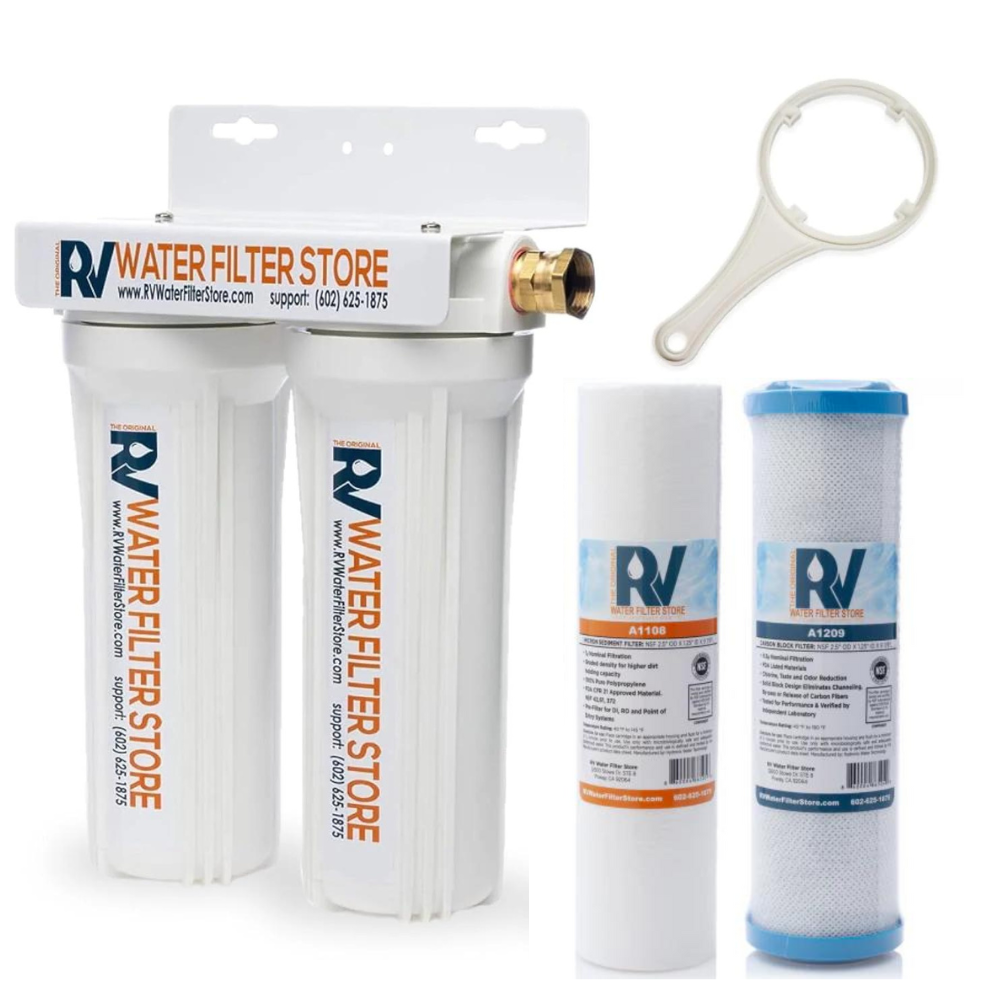
| Standard 10-inch | About 9.75–10 inches long and about 2.5 inches in diameter | Standard, Slim Line, 10-inch standard | Compact single or multi-canister systems |
| 10-inch jumbo | About 9.75–10 inches long and about 4.5 inches in diameter | Jumbo, Big Blue, 10-inch jumbo, 10 x 4.5 | Higher-capacity or higher-flow canister systems |
The standard and jumbo versions may have nearly the same length but very different diameters. A narrow standard cartridge is not a substitute for a jumbo cartridge, and a jumbo cartridge will not fit into a narrow standard housing.

Standard 10-inch cartridges
Standard cartridges are narrower and are common in compact RV systems. They may be used as:
- Sediment filters
- Carbon block filters
- Granular activated carbon cartridges
- Specialty cartridges
- Fine filtration or polishing stages
A standard cartridge may have open ends, molded end caps, gaskets, or O-rings depending on the system. Do not rely on the words “10-inch standard” alone if your system uses a special cartridge head.
10-inch jumbo cartridges
Jumbo cartridges are wider and contain more media volume than standard cartridges of the same approximate length. They are often used when a system needs more capacity or flow area.
Jumbo cartridges may be available as:
- Pleated sediment filters
- Polyspun sediment filters
- Carbon block cartridges
- Granular carbon cartridges
- Specialty media cartridges
- Multi-purpose sediment and carbon cartridges
A jumbo housing should be matched with a cartridge labeled for the correct jumbo or 10 x 4.5-inch format, along with the correct end configuration.
How to identify the cartridge in your RV system
Before ordering a replacement, collect as much information as possible. You may be able to identify the cartridge without removing the housing.
1. Read the cartridge label
Look for information printed on the cartridge wrapper, end cap, or label. Useful details may include:
- Manufacturer or brand
- Cartridge model number
- Length
- Diameter
- Micron rating
- Media type
- Flow direction
- NSF or other performance information
- Replacement part number
- “Standard,” “jumbo,” “Big Blue,” or “10 x 4.5” language
Take a clear photograph before discarding the old cartridge. Even a partial model number can help narrow down the replacement.
If the label is faded, check the ends of the cartridge. Some manufacturers print the model or end-cap information on the top or bottom rather than the side.
2. Inspect the filter housing
The housing head or sump may include useful information molded into the plastic or printed on a label. Look for:
- Cartridge size
- System model
- Inlet and outlet port size
- Flow direction arrows
- Brand markings
- “BB,” “Big Blue,” “Jumbo,” or “Standard” designations
- A serial or part number
The housing’s outside diameter can also provide a clue. A wide sump generally indicates a jumbo cartridge, while a narrow sump generally indicates a standard cartridge. This is only an initial clue; confirm by measuring the cartridge or checking the system documentation.
3. Check the owner’s manual or installation sheet
The manual is often the most reliable source because it can identify more than just size. It may specify:
- Exact replacement cartridge models
- Approved media types
- Maximum flow
- Recommended micron ratings
- Cartridge orientation
- Housing pressure and temperature limits
- O-ring or gasket requirements
- Replacement intervals
- Whether the system uses a proprietary head
If the manual lists a specific cartridge model, begin with that information rather than attempting to substitute based only on appearance.
4. Measure the old cartridge
If you no longer have the packaging or manual, remove the cartridge and measure it carefully.
Measure:
- Overall length: Measure from end to end without compressing the cartridge.
- Outside diameter: Measure across the widest part of the cartridge.
- End-cap design: Note whether both ends are open, whether one end is closed, and whether there are gaskets or O-rings.
- Center opening: If the cartridge has a center tube or opening, measure or photograph it.
- End-cap depth: Some cartridges have recessed or extended ends that affect how they seat.
A cartridge described as “10-inch” may measure slightly less than 10 inches because it is designed to fit inside a housing with room for the sump and seals. Small dimensional differences can be normal, but a major difference in diameter or end design is a compatibility warning.
5. Examine the inlet and outlet style
Not every RV filter uses a cartridge that drops into a screw-together canister.
Some systems use:
- Drop-in cartridges inside removable housings
- Inline cartridges with hose fittings already attached
- Threaded cartridges that screw into a filter head
- Bayonet-style cartridges
- Cartridges with one or more O-rings on a molded end cap
- Proprietary heads with keyed or specially shaped connections
An inline cartridge may have an arrow showing the direction of water flow. It may also include garden-hose fittings or other connections that are specific to the head or hose arrangement. These cartridges should not be treated as interchangeable with ordinary drop-in cartridges.
For compact inline options, compare products in the RV Water Filter Store inline filter collection, and confirm whether the replacement is intended to replace the complete inline unit or only a cartridge inside a reusable head.
Cartridge media: choose for the water problem
Once the physical fit is confirmed, choose the filtration media based on the water you encounter and the purpose of each stage.

Sediment cartridges
Sediment cartridges are designed to reduce suspended particles such as:
- Sand
- Dirt
- Rust
- Silt
- Pipe scale
- Visible debris
Common sediment materials include spun polypropylene, pleated polypropylene, and other depth-filter designs.
A sediment cartridge is often used as the first stage because it protects downstream carbon or specialty cartridges from becoming loaded with larger particles. In a multi-stage RV system, a coarser sediment stage may be followed by a finer sediment or carbon stage.
Sediment cartridges are not all equivalent. A cartridge with a finer micron rating may capture smaller particles, but it can also load more quickly or restrict flow sooner in water with heavy sediment.
Carbon block cartridges
Carbon block cartridges contain compressed activated carbon. They are commonly selected to improve:
- Chlorine taste and odor
- Unpleasant water odors
- Some organic compounds, depending on the product
- Fine sediment, depending on the cartridge rating and construction
Carbon block cartridges are often used as a final stage after sediment filtration. The specific reduction claims depend on the cartridge design, media, contact time, and verified product specifications.
Do not assume every carbon block cartridge reduces every contaminant. Read the product label and performance information for the specific cartridge.
Granular activated carbon cartridges
Granular activated carbon, often abbreviated GAC, uses loose carbon granules inside a cartridge. GAC cartridges can be useful for taste and odor improvement and may be designed with additional sediment-control material.
Because loose carbon can release small carbon particles when first installed, some GAC cartridges include a post-filter or require thorough flushing. Follow the manufacturer’s flushing instructions before using the water for drinking or cooking.
A GAC cartridge also needs to be held securely inside the housing. A cartridge with the wrong length or end seal may allow water to travel around the media rather than through it.
Specialty cartridges
Specialty cartridges are designed for particular water concerns. Examples may include cartridges marketed for:
- Iron
- Heavy metals
- Microbiological barriers
- Taste and odor
- Fine particulate reduction
- Specific chemical reduction
- Scale conditioning
Specialty media should be chosen carefully. A cartridge designed for one problem is not necessarily a replacement for a sediment or carbon cartridge, even if the dimensions are identical.
For example, a specialty cartridge may have a higher pressure drop than a standard sediment cartridge. It may also require a particular flow range or installation position. Match both the physical specifications and the intended application.
KDF media
KDF is a copper-zinc media used in some water filter cartridges. Depending on the product design, KDF may be used to support chlorine reduction, help control certain metals, or provide bacteriostatic properties during storage.
KDF is not a universal solution for every water concern. Its performance depends on the cartridge design, water chemistry, flow rate, and contact time. If a cartridge uses KDF, verify the manufacturer’s stated purpose rather than assuming it replaces a carbon block or specialty cartridge.
Anti-scale media
Anti-scale cartridges are intended to help reduce the effects of hard-water scale or condition minerals before they enter the RV plumbing system. They are different from a portable water softener.
An anti-scale cartridge does not necessarily remove hardness minerals from water. Instead, it may use a conditioning medium intended to reduce the tendency of minerals to form deposits. The exact mechanism and performance depend on the product.
If you regularly camp where hard water leaves spots, deposits, or rough-feeling water, compare an anti-scale filtration stage with a portable RV water softener. A softener uses a different process and may be more appropriate when the goal is to reduce hardness in the water entering the RV.
Micron rating and flow compatibility
A micron rating describes the approximate particle size a filter is designed to reduce. However, the number alone does not tell you whether a cartridge is appropriate for your RV.
Two important terms are:
- Nominal rating: A general performance rating based on the cartridge’s design and test conditions.
- Absolute rating: A more specific rating indicating a tighter particle-removal threshold under stated test conditions.
A lower micron number generally means finer filtration. It can also mean greater resistance to flow, especially as the cartridge collects sediment.
Consider the tradeoff:
- A coarser sediment cartridge may provide better flow and longer service in heavily sedimented water.
- A finer cartridge may improve particulate reduction but load faster.
- A carbon block may improve taste and odor while also reducing flow compared with a coarse sediment filter.
- A specialty or submicron cartridge may require closer attention to pressure and flow.
The best choice depends on your water source, the number of people using the RV, the system’s design, and the amount of flow you need at the shower and faucets.
Do not install a very fine cartridge simply because its micron number looks more impressive. If the system cannot provide adequate flow through that cartridge, the result may be disappointing performance and frequent replacement.
Why brands are not always interchangeable
Some cartridge formats are widely available from multiple manufacturers, but “same size” does not always mean “same replacement.”
Compatibility can vary because of:
Proprietary filter heads
Some inline and twist-in systems use a proprietary connection. The cartridge may lock into the head with a bayonet, keyed shape, or molded fitting. A cartridge from another brand may not lock, seal, or release correctly.
Different O-ring seats
A cartridge may use an O-ring on the outside of the end cap, an internal O-ring, a flat gasket, or a different sealing arrangement altogether. Even a small change in O-ring location can prevent the cartridge from sealing.
Different end-cap designs
Drop-in cartridges may have:
- Two open ends
- One open end and one closed end
- Flat end caps
- Recessed ends
- Extended end caps
- Internal or external O-rings
The housing must be designed for that end style.
Different connections
Inline units may use garden-hose threads, quick connects, push-to-connect tubing, or other fittings. A cartridge with the wrong inlet or outlet connection may require unsafe adaptations or create a leak point.
Different flow direction
Some cartridges are designed to flow from the outside inward, while others use a center-out or head-specific flow path. Follow the arrow or installation instructions. Reversing the flow can reduce performance or disturb the media.
What happens if you force an incompatible cartridge?
Never force a cartridge into a housing or head. If it does not seat naturally, stop and identify the mismatch.
Forcing it can cause:
Leaks
A crushed, stretched, or misplaced O-ring may leak as soon as the water is turned on. In an RV, even a small leak can damage cabinetry, flooring, stored items, or electrical components.
Bypass
If the cartridge does not seal at the top and bottom, water may flow around the media. The filter may appear installed while providing little effective filtration.
Pressure drop
A cartridge that is too restrictive, too fine, or too small for the housing may cause weak faucets, slow filling, poor shower flow, or cycling in a pump-fed system.
Reduced contaminant reduction
The media must receive the intended flow through the correct path. A cartridge that is physically present but poorly seated may not deliver the reduction listed on its label.
Damaged housing parts
Forcing a cartridge or over-tightening the sump can damage the cartridge seat, housing threads, bracket, or O-ring. Plastic components can crack when excessive force is used.
Compatibility checklist before ordering
Use this checklist before selecting a replacement:
Physical fit
- Is the cartridge standard 10-inch or 10-inch jumbo?
- Does the length match the housing specification?
- Does the outside diameter match?
- Does the center opening match, if applicable?
- Does the cartridge have the correct end-cap style?
- Are the gasket and O-ring locations correct?
System connection
- Is this a drop-in cartridge, inline filter, threaded cartridge, or proprietary cartridge?
- Does the inlet and outlet arrangement match?
- Does the cartridge have a required flow-direction arrow?
- Does the head accept the cartridge’s connection and locking style?
Filtration performance
- Is the media appropriate for your water problem?
- Does the micron rating suit your desired flow?
- Does the cartridge’s rated flow meet your RV’s needs?
- Are the pressure and temperature limits appropriate?
- Are the contaminant-reduction claims relevant to your water?
Installation
- Do you have the correct housing O-ring or gasket?
- Is the housing clean and free from old media or debris?
- Will you flush the cartridge according to the instructions?
- Will you check every connection for leaks before leaving the system unattended?
If any answer is uncertain, use the old cartridge label, housing model, and clear photographs to confirm the replacement before ordering.
Replacement installation and verification
After purchasing a cartridge that matches your system, shut off the water supply and relieve pressure before opening the housing.
A typical drop-in cartridge replacement involves:
- Turn off the campground spigot or onboard water pump.
- Open a faucet briefly to relieve pressure.
- Remove the housing sump according to the system instructions.
- Remove the old cartridge and inspect the housing.
- Clean sediment or loose debris from the sump.
- Inspect the housing O-ring for cracks, flattening, or pinching.
- Confirm the new cartridge’s length, diameter, and end design.
- Install the cartridge in the correct orientation.
- Reinstall the sump without cross-threading.
- Turn the water on slowly.
- Check the housing and fittings for leaks.
- Flush the cartridge until the water runs clear and follows the product instructions.
- Check water flow at a faucet and shower.
Do not use the system if the sump continues to leak after proper tightening. A damaged O-ring, cracked housing, incorrect cartridge, or damaged seat may need attention.
Troubleshooting common compatibility symptoms
| Symptom | Likely mismatch or installation issue | What to check |
|---|---|---|
| Housing will not close | Cartridge is too long, too wide, or has the wrong end cap | Confirm cartridge length, diameter, and end style |
| Sump tightens but leaks | O-ring is damaged, misplaced, dry, or not the correct size | Inspect the housing seal and verify the cartridge seats correctly |
| Water flows but tastes unchanged | Water may be bypassing the media or the media is not designed for the target issue | Check end seals, flow direction, media type, and flush the cartridge |
| Sudden weak faucet flow | Cartridge is clogged, too fine, installed backward, or not rated for the system’s flow | Check micron rating, flow arrow, pressure, and sediment loading |
| Carbon particles appear in water | GAC fines or carbon dust are being released during startup | Flush according to instructions and confirm the cartridge is seated |
| Cartridge rocks inside the sump | Cartridge diameter is too small or the housing requires a different format | Match standard versus jumbo size |
| Cartridge cannot lock into the head | Proprietary connection or bayonet design does not match | Use the specified replacement for that head |
| Leak occurs at the hose connection | Inlet or outlet fitting is the wrong type or is cross-threaded | Verify connection style, gasket, thread, and hose fit |
| Pressure is acceptable but filtration is poor | Cartridge may be the wrong media or water may be bypassing it | Confirm the cartridge’s intended use and sealing surfaces |
| Replacement clogs unusually fast | Water has heavier sediment, cartridge is too fine, or a prefilter is missing | Consider staged filtration or a more suitable sediment rating |
When a water softener is the better match
A filter cartridge and a water softener address different water concerns.
A sediment or carbon cartridge can help with particles, chlorine taste, and odors depending on its design. A portable RV water softener is intended for hard-water concerns such as mineral scale and the effects of hardness on plumbing, fixtures, and appliances.
If your main complaint is white scale, spotting, stiff fixtures, or hard-feeling water, changing from one carbon cartridge to another may not solve the problem. In that case, consider whether a portable softener should be used before the RV filtration system or in the arrangement recommended for your equipment.
The correct setup depends on your water source, plumbing layout, and the instructions for each product. A softener is not a substitute for a sediment filter, and a filter cartridge is not a substitute for a softener.
Accessories can affect compatibility too
The cartridge is only one part of the water connection. Hoses, quick connects, pressure regulators, and adapters can also affect how the system performs.
Check that:
- The hose connection matches the system inlet and outlet.
- Quick connects are fully engaged and compatible.
- Threaded fittings are not cross-threaded.
- Gaskets are present where required.
- The pressure regulator is installed in the correct position.
- The regulator and housing are appropriate for the available campground pressure.
- Hoses and fittings are intended for potable-water use.
A correctly matched cartridge cannot compensate for a leaking hose or an incorrect connection. If flow problems begin after changing hoses or adapters, inspect those components before replacing the cartridge again.
How Subscribe & Save helps prevent cartridge mix-ups
Replacement schedules are easier to manage when the correct cartridge is already associated with your system. RV Water Filter Store’s Subscribe & Save option can help by sending the selected replacement on a recurring schedule instead of requiring you to identify and reorder it each time.
Before starting a subscription:
- Confirm the cartridge model currently installed.
- Verify that it matches your housing and filtration needs.
- Choose a quantity that fits your system.
- Select a delivery interval based on your travel and water use.
- Keep the original cartridge packaging or model number for future reference.
- Adjust, skip, or cancel the schedule if your travel plans change.
A subscription should be built around the cartridge that fits your system: not simply the cartridge you purchased most recently. If you change from a standard canister to a jumbo system, add a new filtration stage, or replace an inline filter with a whole-RV system, review the subscription before the next shipment.
Final compatibility check
The safest replacement cartridge is the one that matches your housing in every important way:
- Correct length
- Correct diameter
- Correct end-cap and sealing design
- Correct inlet and outlet arrangement
- Correct flow direction
- Correct micron rating
- Correct media for the water problem
- Correct pressure and temperature specifications
For many RV owners, the first major decision is whether the system uses a standard 10-inch cartridge or a 10-inch jumbo cartridge. From there, confirm the cartridge’s end design and choose media based on the water conditions you encounter.
When in doubt, do not force the cartridge or rely on a similar-looking product. Compare the old cartridge, housing label, owner’s manual, and replacement specifications before installation. That small amount of checking can prevent leaks, bypass, weak flow, and disappointing filtration on your next trip.