

Choosing an RV filter is easier when you start with your water conditions and travel habits instead of shopping by the number of canisters alone. A weekend camper who usually connects to clean municipal water may need a different setup than a full-time RVer who moves between campground hookups, private wells, and rural water systems.
RV Water Filter Store organizes whole-RV filtration into three practical protection levels:
- Essential: Everyday sediment and carbon filtration for basic whole-RV protection
- Enhanced: Added specialty media for scale, iron, sulfur, or heavy-metal concerns
- Elite: The highest level of contaminant reduction, including a 0.2-micron Virus Hero stage in the top-tier system
All three levels are designed to filter water before it enters your RV. The right choice depends on what you want to remove, how often you travel, how much water your household uses, and how much maintenance you are willing to handle.
What does a whole-RV water filter do?
A whole-RV water filter is installed at the incoming water connection so treated water flows through the RV’s plumbing system. Instead of filtering water only at one faucet, a point-of-entry system can improve the water used for:
- Drinking and cooking
- Showers
- Bathroom faucets
- Dishes
- Ice makers
- Washing machines
- Water heaters
- Toilet valves and other fixtures
Campground water can contain sediment, rust particles, chlorine, unpleasant odors, and minerals that vary from one location to another. Even water that meets local drinking-water standards may taste different when you travel, and older campground plumbing can introduce visible particles into the water line.
A whole-RV system helps reduce those common issues before the water reaches your fixtures. Sediment media catches particles such as sand, silt, and rust. Carbon blocks reduce chlorine, taste, odor, and selected chemical contaminants. Specialty cartridges can address concerns such as scale, iron, copper, and hydrogen sulfide.
A water filter is not a substitute for testing an unknown water source. If you regularly use private wells, untreated sources, or water with unusual color or odor, test the water and choose filtration media for the specific problem. Also remember that filtration and water softening do different jobs: a filter targets particles and contaminants, while a softener reduces hardness minerals.
Essential, Enhanced, and Elite at a glance
| Feature | Essential | Enhanced | Elite |
|---|---|---|---|
| Best fit | Weekend travel and ordinary campground hookups | Frequent travel or specific water problems | Maximum contaminant reduction and higher-protection travel |
| Main stages | 1-micron sediment plus 0.5-micron carbon block | Sediment and carbon plus anti-scale or specialty media, depending on configuration | 0.2-micron Virus Hero plus 0.5-micron anti-scale carbon block |
| Canister format | Dual 10-inch by 2.5-inch | Dual or triple 10-inch by 2.5-inch | Dual 10-inch by 2.5-inch |
| Media | Sediment and carbon block | Sediment, carbon block, anti-scale phosphate, or Metal Trap | Virus Hero and anti-scale carbon block |
| Published flow | 3–4 GPM | 3–4 GPM at 60 PSI for the anti-scale model | Check the selected Elite configuration; dual large-format canisters are designed for whole-RV use |
| Main benefit | Strong everyday protection without unnecessary complexity | Adds treatment for hard-water scale, iron, sulfur, or metals | Finest filtration in the tier lineup, including 0.2-micron protection |
| Installation | Outside hose connection or inside-install version | Outside hose connection, inside-install, or triple-canister configuration | Outside hose connection with mounting bracket |
| Ongoing maintenance | Lowest cartridge count and cost | More cartridges or specialty media to monitor | Highest protection with more attention to cartridge condition |
The table is a starting point, not a ranking of what every RVer should buy. Essential is not “too basic” if your water sources are predictable. Elite is not automatically the best value if your main problem is hard water, because a portable softener may be the more direct solution.
Essential: practical two-stage protection
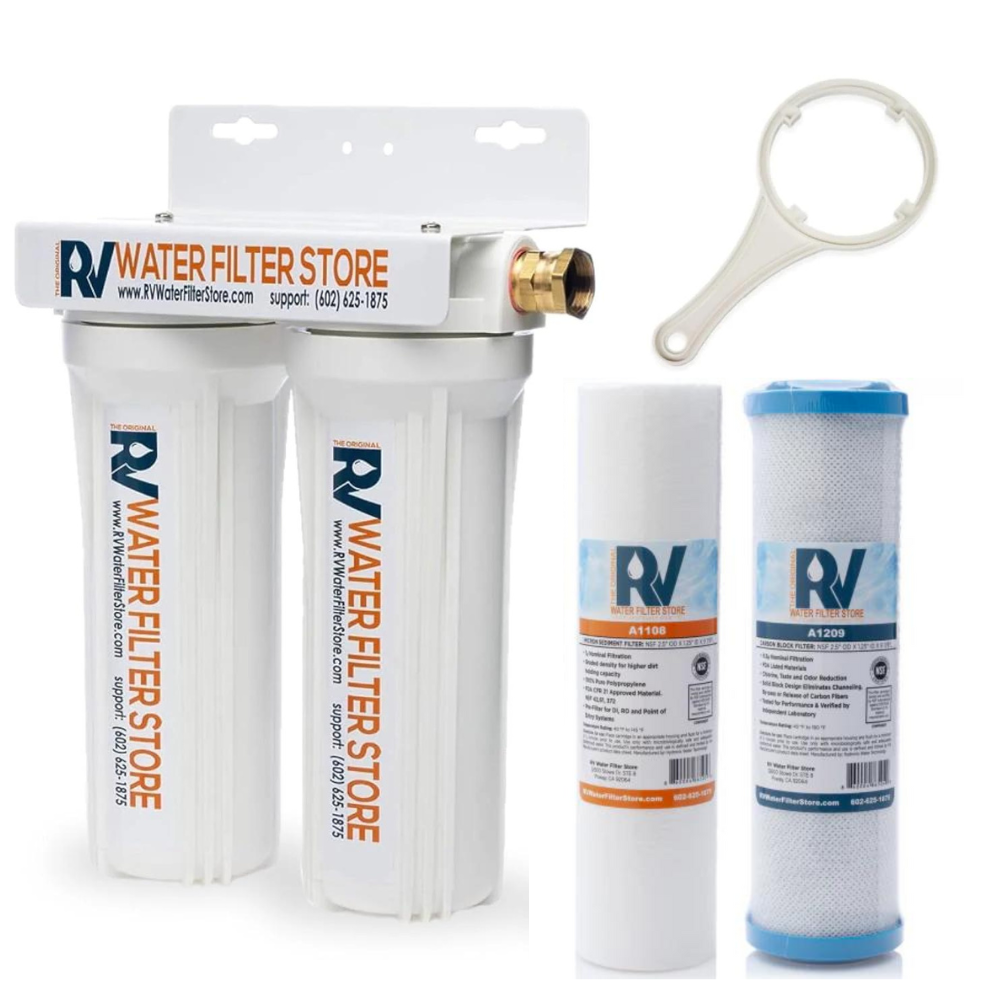
The Essential system is the straightforward choice for RVers who want reliable whole-RV filtration without adding specialty treatment they may not need.
The current Essential Whole-RV Water Filter System uses two standard 10-inch by 2.5-inch canisters:
- A 1-micron nominal sediment filter
- A 0.5-micron carbon block filter
The sediment stage goes first. It catches sand, silt, rust, and other particulate matter before those particles reach the carbon cartridge. The carbon block follows as the polishing stage, reducing chlorine, taste, odor, and selected chemical contaminants.
The system is published at 3–4 gallons per minute, which is suitable for typical RV use when the incoming water pressure is adequate. It also uses standard-size cartridges rather than a proprietary cartridge format. That makes replacement planning easier and gives you more flexibility when it is time to restock.
Who should choose Essential?
Essential is a sensible fit for:
- Weekend warriors who use their RV for short trips
- Families who mostly stay at established campgrounds
- RVers who connect to treated municipal water
- Owners who want improved taste and odor without a complicated installation
- Anyone replacing a basic disposable inline filter with a more capable system
- Travelers who want to protect RV plumbing from sediment
It is also a good starting point if you are not sure what your water conditions will be and want a serviceable whole-RV foundation. You can later change cartridge types if your travel pattern changes.
What Essential does not do
The Essential system is not intended to be a universal treatment solution for every water source. Its product specifications state that it is not rated for bacteria or viruses. It also is not the right cartridge combination for significant iron, hydrogen sulfide, or heavy-metal problems.
If your water leaves orange stains, smells like rotten eggs, or has a persistent metallic taste, move up to a specialty Enhanced configuration rather than expecting a standard sediment-and-carbon setup to solve the issue.
Enhanced: add treatment for the water problem you actually have
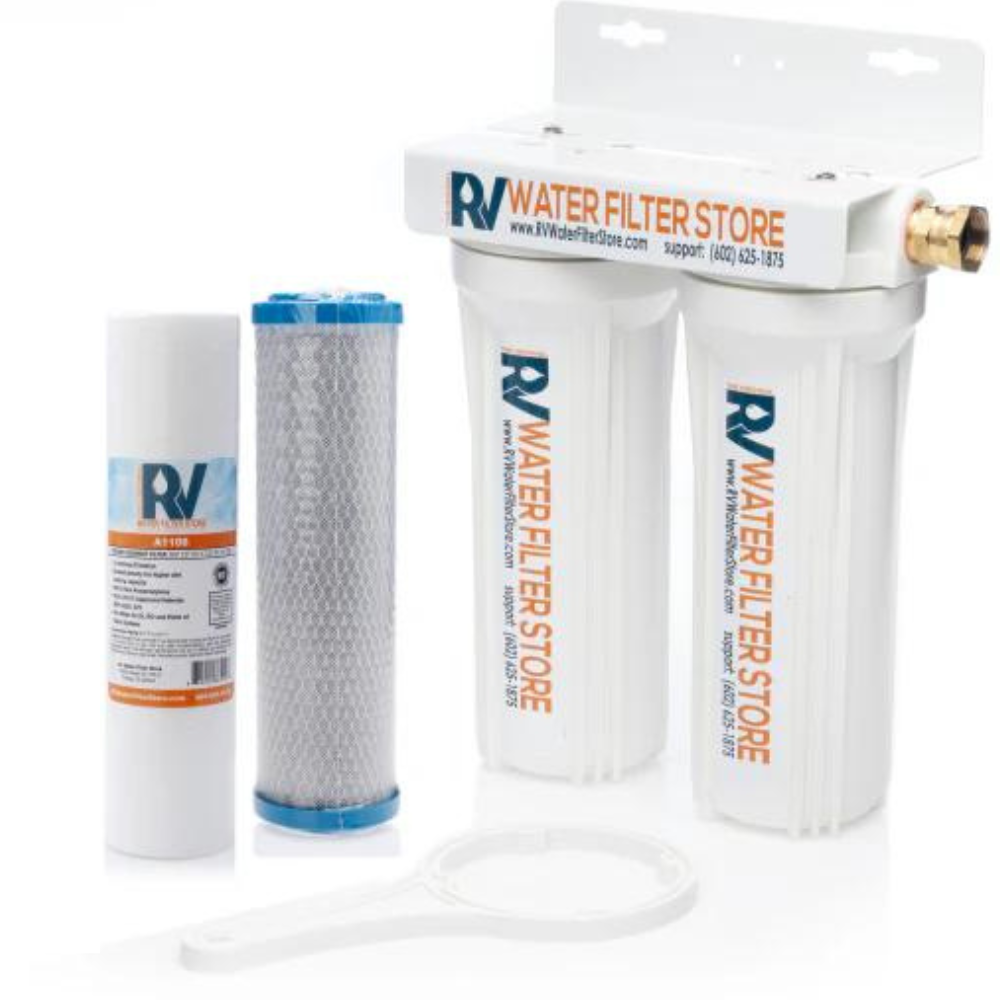
Enhanced is not one single cartridge combination. It is the tier for RVers who need more than basic sediment and carbon filtration but whose needs may be specific.
Two common Enhanced directions are:
- Anti-scale protection for hard-water conditions
- Iron, sulfur, and heavy-metal treatment for problem water
Enhanced anti-scale configuration
The Enhanced anti-scale system uses:
- A 1-micron sediment stage
- A 0.5-micron carbon block with food-grade phosphate for scale inhibition
The system is published at 3–4 GPM at 60 PSI, with a maximum pressure of 65 PSI. The anti-scale cartridge reduces chlorine, taste, and odor while helping limit the scale buildup associated with hard water.
This is an important distinction: an anti-scale cartridge is not the same as a water softener. It helps inhibit scale, but it does not fully remove hardness minerals from the water. If your goal is softer-feeling shower water, less soap scum, and reduced hardness entering the RV, consider adding a portable RV water softener.
Enhanced iron and heavy-metal configuration
The Enhanced iron system uses three standard canisters:
- A 1-micron sediment filter
- A 0.5-micron carbon block
- A Metal Trap cartridge
The Metal Trap media is designed for iron, copper, and hydrogen sulfide. Those problems may show up as red or orange staining, metallic taste, or sulfur odor. The sediment and carbon stages still matter because they protect the specialty cartridge and improve the overall water profile.
This configuration is especially relevant for:
- Private-well hookups
- Rural campgrounds
- Water that causes orange staining
- Water with a rotten-egg odor
- Travelers who frequently encounter metallic taste or visible deposits
The useful life of specialty media depends heavily on the concentration of the contaminant. A cartridge exposed to high iron or sulfur may need replacement sooner than one used on relatively clean municipal water. Treat cartridge-life estimates as planning guidance, not a guarantee.
Who should choose Enhanced?
Choose Enhanced when one of these statements sounds familiar:
- You travel often and encounter inconsistent campground water
- Hard water is leaving scale on faucets or in the water heater
- Your water has iron staining or a sulfur smell
- You want specialty media without moving to the highest-protection configuration
- You spend part of the year on well water
- You want to protect plumbing and appliances from a known regional water issue
Enhanced is often the most practical tier for full-time RVers because it can be matched to the problem rather than adding every available treatment stage.
Elite: the strongest contaminant-reduction option in the lineup
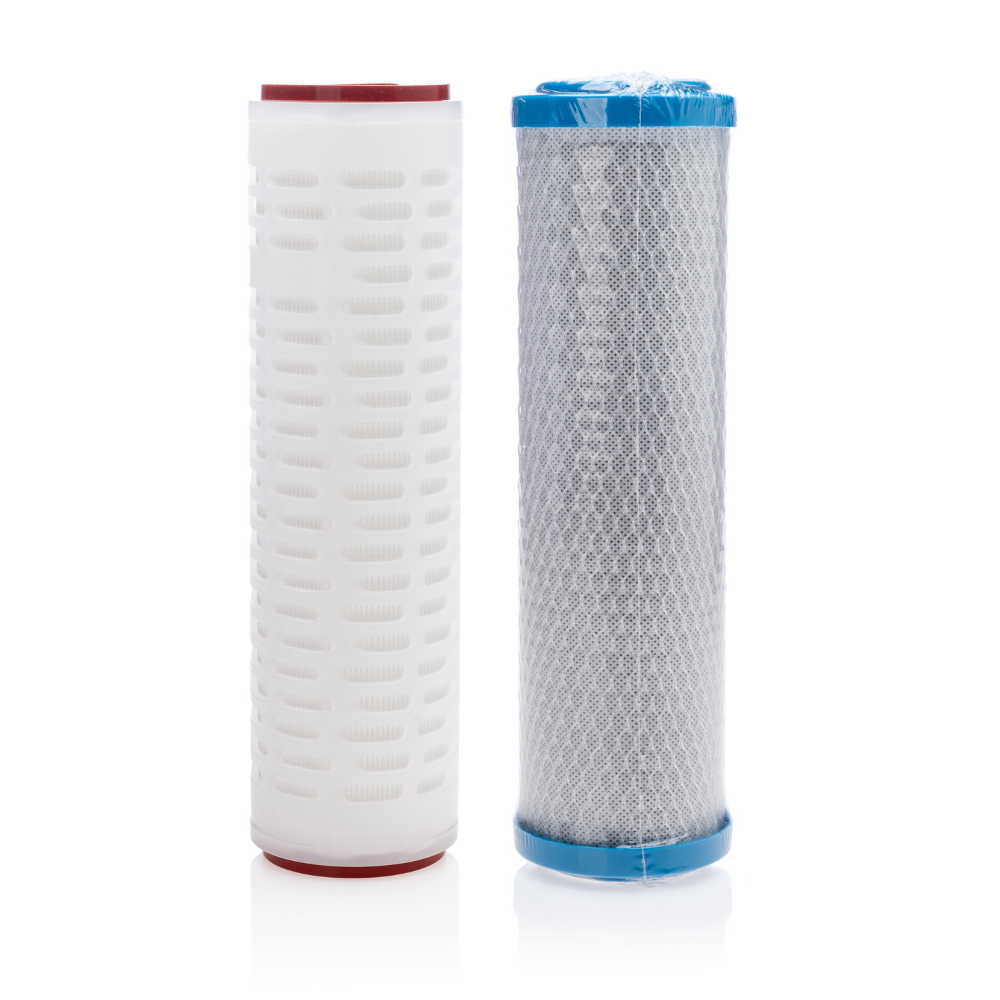
The Elite top-tier system is built for RVers who prioritize the finest filtration in the whole-RV lineup. Its two-stage configuration uses:
- A 0.2-micron Virus Hero filter
- A 0.5-micron anti-scale carbon block
The Virus Hero stage is described by the product specifications as an absolute 0.2-micron filter intended to reduce bacteria and cysts. The carbon block reduces chlorine, taste, odor, VOCs, PFAS, and pesticides while also helping with scale buildup.
Elite provides a higher level of contaminant reduction without requiring a large three-canister tower. It keeps the dual-canister, standard 10-inch by 2.5-inch format, which helps simplify cartridge compatibility and installation.
Who should choose Elite?
Elite may be the right fit for:
- Full-time RVers who use their RV water system every day
- Families who want the highest level of whole-RV filtration available in the lineup
- Travelers who move between different municipal systems
- RVers who spend extended periods in areas where water quality is uncertain
- People who want a 0.2-micron Virus Hero stage at the point of entry
- Owners who want anti-scale carbon treatment along with fine filtration
Elite is also useful for travelers who want to reduce reliance on disposable inline filters. However, a whole-RV filter should not be treated as a guarantee that every unknown water source is safe to drink. Follow the cartridge specifications, observe replacement intervals, and use a dedicated drinking-water system when your source requires additional treatment.
What about Elite flow rate?
Flow is a critical consideration with any fine filter. Finer media can create more resistance as it loads with sediment, especially when campground pressure is low.
The Essential system is published at 3–4 GPM, and the Enhanced anti-scale system is published at 3–4 GPM at 60 PSI. The Elite top-tier product page emphasizes its dual large-format canisters and 0.2-micron filtration but does not list a separate GPM figure in the specifications reviewed for this article. For that reason, do not assume a higher flow rate simply because the product is in the Elite tier.
Instead:
- Check the specifications for the exact Elite configuration
- Use a pressure regulator to protect the RV while maintaining appropriate incoming pressure
- Keep the sediment stage from becoming overloaded
- Replace cartridges when flow drops noticeably
- Avoid stacking multiple restrictive filters before the RV inlet
Elite’s advantage is its higher level of contaminant reduction in a dual-canister whole-RV format. Your actual flow will depend on source pressure, hose diameter, cartridge condition, and how many fixtures are running at once.
Micron ratings: why lower is not always simpler
A micron rating describes the size of particles a filter is designed to capture. A lower number generally indicates finer filtration, but finer filtration can also increase resistance and make cartridge maintenance more important.
The tier ratings in this lineup work as follows:
- 1 micron nominal sediment: Captures fine sediment such as sand, silt, and rust particles before they reach later stages.
- 0.5-micron carbon block: Reduces chlorine, taste, odor, and selected contaminants while providing a fine filtration barrier.
- 0.5-micron anti-scale carbon block: Combines carbon filtration with scale-inhibiting media.
- 0.2-micron Virus Hero: Provides the finest filtration in the top-tier lineup and is designed to reduce bacteria and cysts according to the product specifications.
Micron size alone does not tell you what a filter removes. Media type matters just as much. A sediment cartridge and a carbon block can have different jobs even when their micron ratings appear similar. Specialty media such as Metal Trap or phosphate-based anti-scale media addresses a different problem than ordinary sediment filtration.
Flow rate and pressure: protect your shower pressure
A whole-RV filter should make water better without making the RV difficult to use. Before buying, consider:
Your campground pressure
Many RV parks provide moderate water pressure, and some connections may be much lower than expected. Use a regulator at the campground spigot to protect RV plumbing. A regulator with a gauge can help you see whether poor flow originates at the campground, the hose, the regulator, or the filter.
Your household demand
A couple traveling in a small trailer may use one faucet at a time. A family in a large motorhome may run a shower while another person uses the kitchen faucet. That makes large-format canisters and adequate flow capacity more important.
Cartridge condition
A new filter may flow well, while the same cartridge can restrict water after collecting sediment for weeks or months. A sudden pressure drop is a maintenance signal. Check the cartridge rather than compensating by removing the regulator or exceeding the system’s pressure limits.
Installation order
For an outside installation, a practical order is:
Campground spigot → pressure regulator → hose → RV water filter → RV inlet
The exact order may vary depending on your equipment and the manufacturer’s instructions, but the regulator should protect the filtration system and the RV from excessive pressure. Make sure the sediment stage is first in a multi-stage system.
Installation requirements for each tier
Essential installation
The outside Essential system uses garden-hose connections, a dual mounting bracket, two canisters, and a standard canister wrench. Installation generally involves:
- Mounting or stabilizing the bracket
- Connecting the incoming hose to the filter inlet
- Connecting the filtered outlet to the RV
- Confirming that the sediment cartridge is first
- Flushing new cartridges according to the instructions
- Checking all fittings for leaks
An inside-install Essential version is also available for RVs with suitable 1/2-inch PEX plumbing. Inside installation is more permanent and may require cutting or rerouting the water line, so it is best suited to owners comfortable with RV plumbing or working with a qualified installer.
Enhanced installation
The dual-canister anti-scale system installs much like the Essential system. The triple-canister iron and heavy-metal configuration requires more space, additional connections, and a stable mounting location.
Before installing Enhanced, measure:
- Available width and height
- Clearance below the canisters for cartridge changes
- Hose-routing distance from the spigot
- Bracket mounting points
- Storage space for spare cartridges
Inside-install Enhanced systems are available in selected configurations with 1/2-inch PEX connections. Confirm the exact version before ordering.
Elite installation
The Elite top-tier system uses dual canisters, a bracket, hose fittings, and a canister wrench. The installation is similar to the outside Essential system, but cartridge orientation and flushing are especially important because the 0.2-micron Virus Hero stage is a fine filtration element.
Do not bury the system where you cannot inspect it. Keep it protected from freezing temperatures, direct damage, and unnecessary strain on the hose connections.
Replacement cartridge costs over time
The purchase price is only part of the cost of an RV filter. Cartridge replacement is the ongoing expense that matters most over several seasons.
The store’s listed refill examples include:
- Essential System Filter Refill Kit: $57.95, containing two 1-micron sediment filters and one 0.5-micron carbon block
- Enhanced anti-scale refill kit: listed at $74.95
- Enhanced iron and heavy-metal refill kit: listed at $129.95, containing two sediment cartridges, a carbon block, and a Metal Trap cartridge
- Elite refill costs: vary by the specific Elite configuration and cartridge kit
Prices can change, so use the current Replacement Filter Cartridges collection as the reference point before calculating your annual budget.
Here is a simple planning example using the listed Essential refill price:
| Replacement schedule | Approximate refill purchases per year | Example annual cartridge cost |
|---|---|---|
| Every 3 months | 4 | $231.80 |
| Every 6 months | 2 | $115.90 |
| Once per year | 1 | $57.95 |
These are arithmetic examples, not universal replacement recommendations. A full-time RVer using high volumes of water or traveling through sediment-heavy locations may replace cartridges more often. A weekend traveler with clean municipal water may use a different schedule.
Enhanced systems can cost more to maintain because they may use three cartridges or specialty media. That additional cost can be worthwhile when it prevents iron staining, sulfur odor, or scale problems that a basic cartridge cannot address.
How Subscribe & Save helps
Subscribe & Save is useful when you already know your normal replacement rhythm. The program allows customers to select delivery intervals, save on eligible replacement filters, change or skip shipments, cancel when necessary, and update the shipping address while traveling.
It is especially helpful for:
- Full-time RVers
- Seasonal travelers
- Families using large amounts of water
- Owners who do not want to identify cartridge SKUs each time
- Anyone who has previously forgotten to order replacements
Choose a schedule based on actual use, then adjust it when you inspect your cartridges. If you travel to a location with unusually dirty water, you may need a replacement sooner than your automatic shipment.
Whole-RV system or inline filter?
An inline filter is compact and convenient. It can be a good option for a short trip, a spare setup, or an RVer who needs a simple connection with minimal storage.
However, a dual-canister whole-RV system offers several advantages:
- A dedicated sediment stage protects the carbon cartridge
- Larger cartridges can provide more capacity
- Standard 10-inch by 2.5-inch cartridges are easy to replace
- Specialty media can be added for scale, iron, or metals
- A bracket provides a more stable installation
- The system can serve the entire RV rather than only a short hose connection
Browse In-Line Filters if compactness is your top priority. Choose a whole-RV system when you want a more serviceable, configurable setup for regular use.
Should you add a water softener?
A filter and a softener solve different problems.
A filter reduces particles, chlorine, odors, and selected contaminants based on its media. A portable water softener reduces hardness minerals that contribute to scale and dry-feeling water.
Consider adding a portable softener if:
- Your campground water leaves white scale
- Soap does not lather well
- Your water heater accumulates mineral deposits
- Faucets and showerheads develop crusty buildup
- You frequently camp in hard-water regions
An Enhanced anti-scale cartridge can help inhibit scale, but it is not a replacement for a true softener when hardness reduction is your primary goal. The two products can be used together when your water conditions justify both.
Final decision: which RV filter tier is right for you?
Choose Essential if you mostly visit established campgrounds, want better taste and odor, and need everyday sediment protection with a manageable replacement cost.
Choose Enhanced if your travel involves inconsistent water sources or you have a defined problem such as hard-water scale, iron, sulfur odor, or heavy metals. Select the cartridge configuration that matches the problem rather than assuming every Enhanced system treats the same contaminants.
Choose Elite if you want the highest contaminant-reduction level in the lineup, including a 0.2-micron Virus Hero stage, and you are prepared to monitor fine filtration and replace cartridges on schedule.
When in doubt, begin with three questions:
- Where do I get most of my water?
- What problem am I trying to solve: sediment, taste, scale, iron, or microbiological concerns?
- Can I maintain and replace the cartridges on the schedule my travel requires?
You can compare current configurations in the RV Water Filtration Systems collection. Match the system to your water conditions, protect the connection with an appropriate regulator, and keep replacement cartridges on hand so your RV water stays cleaner from one destination to the next.

