

An under-sink water filter system is one of the most practical drinking-water upgrades you can make to an RV. Instead of filtering every gallon used for showers, toilet flushing, and laundry, it treats the water you actually drink and cook with at a dedicated faucet.
That point-of-use approach has several advantages. A compact filter can provide more contact time with carbon media, target contaminants that basic whole-RV filters may not address, and operate without reducing water pressure at every fixture in the rig. The filter remains tucked behind a cabinet door, while the faucet gives you convenient access to cleaner-tasting water at the kitchen counter.
An under-sink system does not necessarily replace a whole-house RV water filter. In many setups, the two work best together:
- A whole-RV filter protects the rig’s plumbing and improves water throughout the coach.
- An under-sink drinking water system provides a final, dedicated treatment step for drinking and cooking water.
This guide explains how RV under-sink systems work, what they can remove, how much cabinet space and flow to expect, how installation works, and how they compare with whole-house canister filtration.
Why a whole-house RV water filter may not be enough for drinking water
Whole-house filtration is an important first line of defense. A dual-canister system can reduce sediment, chlorine, odors, and other common problems before campground water enters the RV. It also helps protect faucets, valves, water heaters, showerheads, and other plumbing components.
However, a whole-house filter has to balance filtration performance with the water demand of the entire RV. A shower or toilet valve may require significantly more flow than a drinking faucet. If the filter is too restrictive, the whole rig can experience reduced pressure.
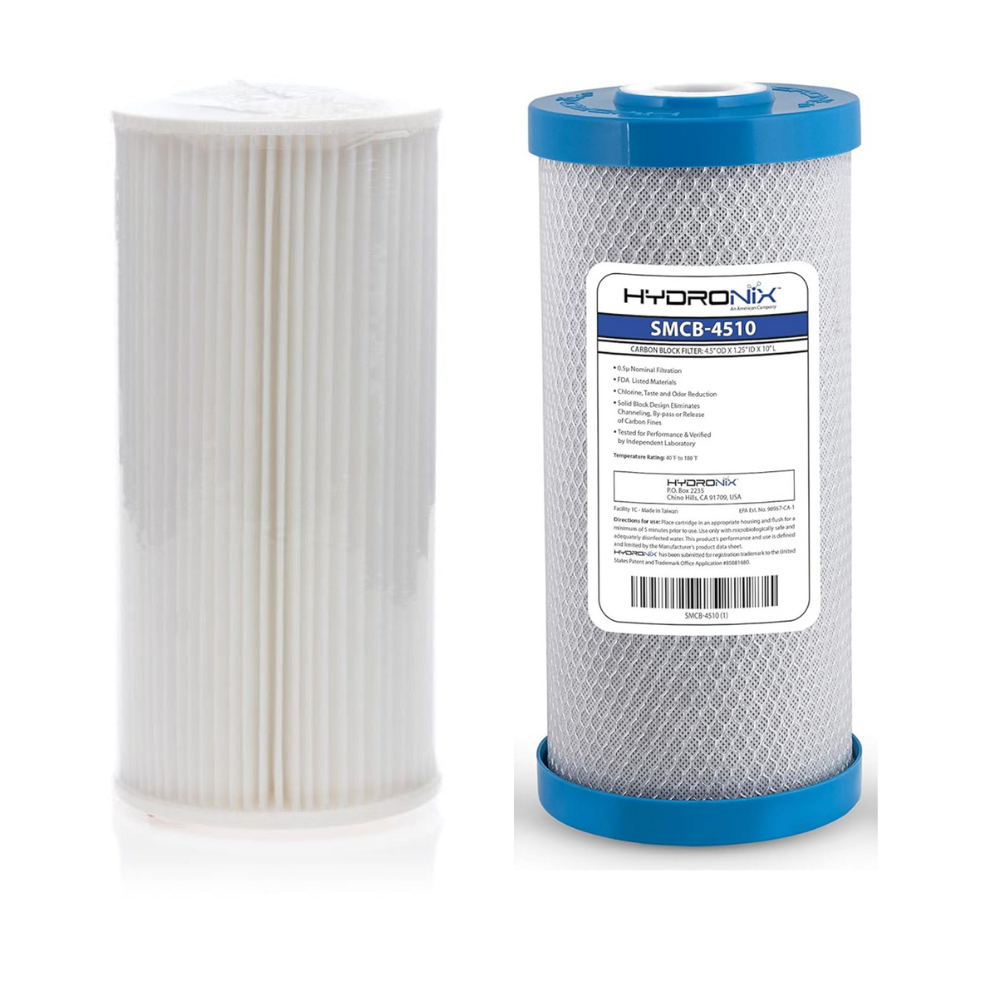
For that reason, many whole-RV systems use a relatively large canister and a staged combination such as:
- A sediment cartridge to trap sand, silt, rust, and other particles.
- A carbon cartridge to improve taste and odor and reduce chlorine and selected chemicals.
That setup is useful, but a basic sediment cartridge and general-purpose carbon filter are not automatically certified to reduce every drinking-water contaminant.
Taste and odors can persist
Chlorine is commonly added to municipal water supplies for disinfection. Even after passing through a whole-RV filter, water may retain a noticeable chlorine taste or odor if the carbon cartridge is undersized, exhausted, or exposed to a high flow rate.
Water can also pick up odors from:
- Campground plumbing
- A drinking-water hose
- An RV’s storage tank
- Biofilm or residue in lines
- Sulfur or other naturally occurring compounds
- Organic chemicals in the source water
A dedicated under-sink filter generally operates at a lower flow rate than a whole-house system. That slower flow gives the water more contact time with the carbon block, which can improve taste and odor reduction at the drinking faucet.
Lead and other metals require the right cartridge
Lead is not something you can identify reliably by looking at, smelling, or tasting water. It may enter water through older plumbing, campground infrastructure, brass components, or fixtures.
A basic sediment filter may capture particulate material, but it is not designed to reduce dissolved lead. Carbon media can reduce lead in some applications, but the cartridge must be specifically designed and rated for that contaminant. When lead reduction is important, look for documented performance claims and applicable certifications rather than relying on the micron rating alone.
Cysts are not the same as ordinary sediment
Giardia and Cryptosporidium are examples of waterborne protozoan cysts. These organisms are larger than many dissolved chemicals, but a filter must be rated for cyst reduction or removal to make that claim meaningful.
A 0.5-micron solid carbon block designed and certified for cyst reduction can help address cysts such as Giardia and Cryptosporidium. However, not every cartridge labeled “0.5 micron” has the same performance. Micron ratings may be nominal or absolute, and contaminant claims depend on the cartridge design, testing, and operating conditions.
VOCs may pass through basic filtration
Volatile organic compounds, or VOCs, are a broad group of chemicals that can affect water taste, odor, and safety. Certain activated carbon blocks are designed to reduce selected VOCs and other organic compounds.
A sediment cartridge will not remove dissolved VOCs. A general carbon cartridge may help with some of them, but the exact performance varies. For drinking water, the filter’s performance data is more important than the word “carbon” on the label.
How an RV under-sink water filter system works
An under-sink system is installed on the cold-water line serving the kitchen sink. It does not filter water to every fixture. Instead, a tee or adapter diverts a small amount of cold water through a dedicated filter and then sends the treated water to a separate auxiliary drinking faucet.
The basic flow path looks like this:
Cold-water supply line → shutoff valve or tee → filter cartridge → auxiliary drinking faucet
The filtered water comes from the small drinking faucet rather than the standard RV faucet. This arrangement allows the filter to be designed specifically for drinking and cooking water.

Compact carbon block systems
Many under-sink drinking-water systems use a compact carbon block cartridge. Carbon blocks are made by compressing activated carbon into a dense filter element. Compared with loose granular carbon, a solid carbon block can offer a more controlled filtration path and substantial contact with the media.
A properly specified 0.5-micron solid carbon block may be designed to reduce:
- Fine sediment and particulate matter
- Chlorine
- Bad taste and odor
- Selected VOCs and organic chemicals
- Lead and other metals, when specifically rated
- Giardia and Cryptosporidium cysts, when specifically rated
The key point is that the micron rating and contaminant claims must be considered together. A 0.5-micron rating alone does not prove lead, VOC, or cyst performance.
Reverse osmosis systems
Some RV owners choose reverse osmosis, or RO, for point-of-use drinking water. RO uses pressure to push water through a semipermeable membrane. The membrane can reduce a broad range of dissolved substances, including many salts and minerals that carbon filtration leaves behind.
RO can be a good choice when water chemistry is a major concern, but it has different installation and operating requirements:
- It generally needs more cabinet space.
- It may use a storage tank.
- It usually produces a waste-water stream.
- Flow at the faucet can be slower without stored water.
- The membrane and prefilters require separate maintenance.
- A drain connection may be required.
For many RV owners who primarily want better taste, odor, chlorine, and targeted contaminant reduction, a compact carbon block system is simpler. For those concerned about dissolved solids or a broader range of dissolved contaminants, RO may be worth considering.
Why the dedicated auxiliary faucet matters
The separate faucet is more than a cosmetic feature. It makes the filtration strategy practical.
A whole-house filter must support:
- Showers
- Kitchen faucets
- Bathroom sinks
- Toilet flushing
- Outdoor rinsing
- Water-heater filling
- Washing and cleaning
An under-sink filter only needs to support the drinking-water faucet. Because the demand is limited, the system can use finer filtration media without placing the same restriction on the rest of the RV.
This lets you preserve normal whole-rig pressure while reserving the higher level of point-of-use filtration for water used in:
- Drinking
- Coffee and tea
- Cooking
- Filling water bottles
- Preparing baby formula
- Rinsing produce
- Filling an ice maker, if the plumbing is compatible
The filtered faucet also makes it easy to identify which water has received the final treatment step.
Choosing the right micron rating and filter media
Microns are units used to describe the size of particles a filter is designed to capture. A smaller micron number generally indicates a finer filtration level, but the number should never be evaluated in isolation.
What a 0.5-micron solid carbon block can do
A 0.5-micron solid carbon block is a common choice for an RV drinking-water application because it balances fine filtration, carbon contact time, and practical faucet flow.
When the cartridge is properly engineered and rated, it can provide reduction of:
- Giardia and Cryptosporidium cysts
- Lead
- Chlorine
- Selected VOCs
- Unpleasant taste and odor
- Fine sediment
- Rust particles and other particulate matter
Cysts are relatively large microorganisms, while lead and VOCs may be dissolved or chemically associated with the water. The filter mechanisms are not identical. Physical filtration helps with particles and cysts; adsorption and specialized media help with chlorine, VOCs, and some metals. This is why a cartridge’s performance data matters more than the micron number alone.
Nominal versus absolute ratings
A nominal micron rating describes the approximate size of particles a filter typically reduces. An absolute rating is a tighter performance specification that indicates a higher level of particle retention under defined test conditions.
If cyst reduction is an important requirement, choose a cartridge with a documented cyst-reduction claim rather than assuming every 0.5-micron filter provides the same result.
Carbon block versus sediment media
Sediment cartridges are designed primarily to trap particles. They are useful as a prefilter and can extend the life of a downstream carbon block.
Carbon blocks are intended to improve taste and odor and reduce selected chemicals through adsorption. They may also provide fine particulate filtration, depending on the design.
A common RV arrangement is:
- Whole-RV sediment filtration for larger particles
- Whole-RV carbon filtration for general water improvement
- Under-sink carbon block filtration for final drinking-water treatment
Cabinet space requirements
Before buying an under-sink system, measure the cabinet rather than estimating. RV cabinets often contain more than a household sink cabinet, including:
- Water lines
- Drain plumbing
- Electrical wiring
- Water-heater components
- Valves
- Drawers or shelf supports
- Structural bracing
A compact single-cartridge system may need only enough room for the cartridge, bracket, tubing bends, and shutoff access. A multi-stage RO system requires additional clearance for prefilters, a membrane housing, a storage tank, and possibly a drain saddle.
Plan for more than the cartridge’s listed height and width. You also need space to:
- Remove the cartridge during replacement
- Turn or twist the filter into its head
- Reach the shutoff valve
- Avoid sharply bending tubing
- Inspect fittings for leaks
- Keep the filter from contacting stored items
Easy-change sanitary twist-off cartridges are particularly useful in tight RV cabinets. Traditional canister housings may require a filter wrench, vertical clearance below the housing, and enough room to remove a large bowl. A twist-off design can simplify replacement when cabinet access is limited.
Installation: what is involved?
Installation difficulty depends on the RV’s plumbing layout and the type of faucet included, but most under-sink systems use straightforward components.
Typical installation components
A standard kit may include:
- Filter cartridge and filter head
- Mounting bracket
- Dedicated drinking-water faucet
- Cold-water tee or adapter
- Shutoff valve
- Quick-connect fittings
- Food-grade tubing
- Faucet hardware
- Installation instructions
Before starting, turn off the RV water pump and disconnect campground water. Open the existing faucet to relieve pressure.
Step 1: Choose the filter location
Select a firm mounting surface inside the cabinet. Keep the filter away from moving drawers, sharp edges, heat sources, and areas where stored items could strike it.
The cartridge should remain accessible. Do not permanently bury it behind a fixed panel unless you are certain it can be removed later.
Step 2: Install the mounting bracket
Secure the bracket to a cabinet wall or other solid structure using appropriate fasteners. Avoid drilling into hidden plumbing, wiring, or tank components.
If the cabinet wall is thin, use fasteners that will not protrude into adjacent compartments. The bracket should support the cartridge without allowing it to swing or pull on the tubing.
Step 3: Tap the cold-water line
Under-sink drinking-water systems should normally be connected to the cold-water supply. Use the correct tee or adapter for the existing RV plumbing.
The connection may be made at:
- The cold-water line serving the sink
- A dedicated cold-water branch
- An existing filtered-water line, if the system is compatible
A shutoff valve is helpful because it allows you to service the filter without shutting down the entire RV water system.
Step 4: Drill for the auxiliary faucet
Many RV sinks do not have an unused faucet hole. If necessary, mark the faucet location and verify that the underside is accessible before drilling.
Check for:
- Clearance below the countertop
- Sink-basin edges
- Cabinet bracing
- Electrical wiring
- Plumbing
- Faucet handle movement
Use the hole size specified by the faucet manufacturer. Protect the finished surface from scratches, remove drilling debris, and secure the faucet with its supplied hardware.
Step 5: Connect the tubing
Push the tubing fully into each quick-connect fitting. A partial connection can leak once the system is pressurized.
Keep tubing runs neat and avoid:
- Kinks
- Tight bends
- Abrasion
- Contact with hot plumbing
- Strain at the filter head
- Unsupported loops that pull on fittings
Use the tubing size and fitting type specified for the system. Do not force incompatible tubing into a fitting.
Step 6: Flush and inspect
Install the cartridge according to its instructions. New carbon filters commonly require flushing to remove air and loose carbon fines.
Turn the water supply on slowly and inspect every connection. Open the dedicated faucet and flush the cartridge until the water runs clear and any initial carbon taste has dissipated.
Check again for leaks after several minutes and once more after the system has been used.
Flow rate: balancing filtration with everyday convenience
Flow rate is measured in gallons per minute, or GPM. For an under-sink drinking faucet, you do not need the same flow rate required by a shower. A drinking faucet commonly operates at approximately 0.5 to 1.0 GPM, depending on the cartridge, pressure, tubing, faucet aerator, and filter condition.
That is usually enough for:
- Filling a glass
- Filling a coffee maker
- Filling a water bottle
- Cooking
- Rinsing small amounts of produce
It may feel slow when filling a large stockpot. That is normal for a fine point-of-use filter.
Factors that affect under-sink flow
Actual flow depends on:
- Campground water pressure
- RV pressure-regulator setting
- Fresh-water pump performance
- Cartridge micron rating
- Cartridge age
- Water temperature
- Tubing length and diameter
- Faucet aerator restrictions
- Mineral or sediment loading
A very fine filter can reduce flow more than a coarser cartridge. If your RV frequently operates on a weak pump or low campground pressure, choose a system with a practical rated flow rather than selecting the finest available filter automatically.
A pressure regulator protects the RV from excessive campground pressure, but an incorrectly adjusted or clogged regulator can also restrict flow. If the drinking faucet suddenly slows, check the cartridge, regulator, shutoff valve, tubing, and faucet aerator before assuming the filter system has failed.
Whole-house filter versus under-sink drinking-water system
| Feature | Whole-house RV filter | Under-sink drinking-water system |
|---|---|---|
| Primary purpose | Treats water entering the entire RV | Provides final treatment at a dedicated drinking faucet |
| Fixtures served | Showers, sinks, toilet, water heater, and other fixtures | Usually one auxiliary faucet, sometimes an ice maker or refrigerator line |
| Typical media | Sediment, carbon, specialty media, or multiple stages | Compact carbon block, ceramic media, RO membrane, or multi-stage combination |
| Contaminants addressed | Sediment, chlorine, taste, odor, and selected contaminants based on cartridge | Fine sediment, chlorine, taste, odor, and targeted contaminants such as cysts, lead, or VOCs when the cartridge is rated for them |
| Cysts, lead, and VOCs | Varies by cartridge; basic systems may not be certified for all three | More targeted point-of-use treatment is possible; verify the cartridge’s performance claims |
| Flow rate | Designed for higher whole-RV demand; larger systems can preserve useful shower and sink flow | Lower flow is common, often about 0.5–1.0 GPM at the dedicated faucet |
| Pressure impact | A restrictive cartridge can affect every fixture | Restriction is limited primarily to drinking-water use |
| Installation | Often outside at the hose bib or in an RV utility bay; some systems install inside | Installed under the sink with a bracket, cold-water tee, tubing, and auxiliary faucet |
| Cabinet space | Usually does not occupy kitchen cabinet space when installed outside | Requires cabinet clearance and access for cartridge changes |
| Maintenance | Replace cartridges based on capacity, pressure drop, discoloration, or time | Replace drinking-water cartridge approximately annually or according to capacity and use |
| Service access | Canister housings may require room for a wrench and bowl removal | Twist-off cartridges are convenient in tight cabinets |
| Cost | Often lower per gallon for treating all RV water | Higher treatment cost per gallon but focused on drinking and cooking water |
| Best use | Protecting the plumbing and improving water throughout the RV | Final point-of-use polishing and targeted drinking-water treatment |
| Best combined setup | Whole-RV prefiltration | Dedicated final drinking-water stage |

Maintenance and cartridge replacement
An under-sink system is only as effective as its cartridge. Even a high-capacity filter eventually becomes exhausted or restricted.
A practical replacement schedule for many RV owners is approximately once per year, although full-time travelers, families, and users dealing with poor-quality campground water may need to replace cartridges sooner. Always follow the cartridge’s stated capacity and replacement instructions.
Replace the cartridge sooner if you notice:
- Reduced drinking-faucet flow
- Returning chlorine taste
- New odors
- A change in water appearance
- Reaching the cartridge’s gallon capacity
- A long period of storage
- Suspected contamination
- A filter that has been exposed to freezing
Do not wait for a cartridge to become completely blocked. As media loads with sediment and contaminants, flow can decline and filtration performance may no longer match the original specification.
Sanitize the system
When replacing the cartridge, clean the accessible filter head, faucet outlet, and tubing connections. If the RV has been stored or the water system has experienced contamination, sanitize the appropriate lines and tanks using an RV-safe process.
Avoid introducing household cleaners or unapproved chemicals into the drinking-water path. Follow the filter manufacturer’s sanitation instructions and flush thoroughly afterward.
Twist-off cartridges versus traditional housings
Traditional canister systems use a reusable housing with a replaceable filter element inside. They can be versatile and economical, but they require:
- A wrench or adequate hand clearance
- Space below the housing
- Careful seating of the O-ring
- Housing cleaning during replacement
- Attention to cross-threading and leaks
Sanitary twist-off cartridges attach directly to a filter head and are removed as one enclosed unit. They are often easier to change in an RV cabinet because there is no large bowl to unscrew or clean.
Whichever design you choose, make sure the replacement cartridge is compatible with the head and system. Cartridge dimensions, connection style, flow direction, and pressure rating must match.
How to choose an under-sink system for your RV
Start with your water sources and travel habits.
Choose a compact carbon block system if:
- You primarily want better taste and odor.
- Chlorinated campground water is your main complaint.
- You want targeted drinking-water filtration without treating every gallon.
- Cabinet space is limited.
- You prefer a simple installation and straightforward cartridge change.
- You want to preserve whole-RV flow while improving drinking water.
Consider a higher-protection or multi-stage system if:
- You frequently use unfamiliar campground water sources.
- You want filtration beyond basic sediment and chlorine reduction.
- You have enough cabinet space for additional stages.
- You are comfortable with more involved maintenance.
- The system’s documented performance matches the contaminants you want to reduce.
Consider reverse osmosis if:
- Dissolved minerals or total dissolved solids are a major concern.
- You want broader dissolved-contaminant reduction.
- You can accommodate a storage tank and drain connection.
- You accept slower direct flow and additional maintenance.
- Your RV plumbing and electrical layout support the installation.
If you already use a whole-RV filter, an under-sink system can serve as a final drinking-water stage rather than duplicating the entire filtration setup. Browse the RV water filtration systems collection for whole-rig options, then compare point-of-use configurations in the under-sink water filter systems collection.
A practical two-stage RV water strategy
For many travelers, the most balanced setup is:
- Whole-RV filtration at the inlet: Reduce sediment and improve water throughout the coach.
- Under-sink point-of-use filtration: Provide a final, targeted treatment step for drinking and cooking water.
- Pressure control: Use a suitable pressure regulator to protect RV plumbing while maintaining adequate flow.
- Routine replacement: Change cartridges based on time, capacity, pressure drop, taste, and water conditions.
- Water testing when needed: Test unfamiliar sources or investigate persistent taste, odor, or water-quality concerns.
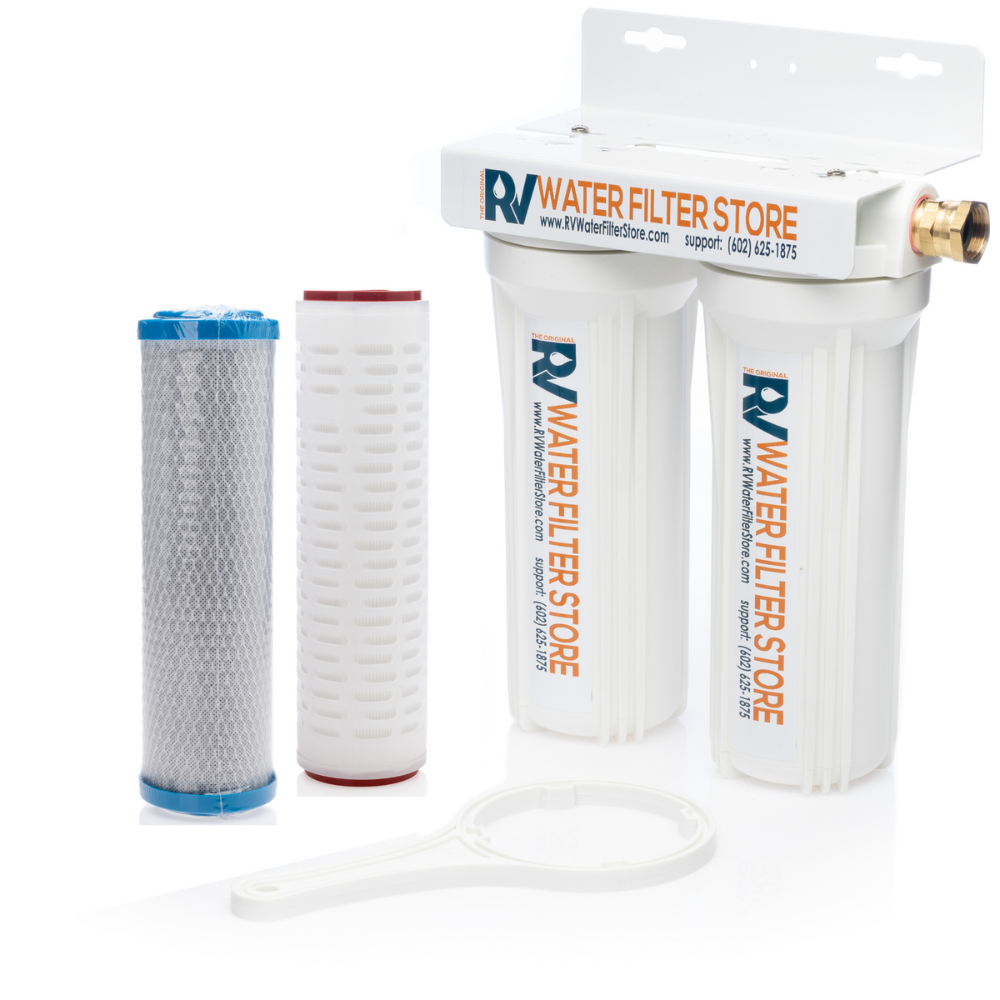
A whole-house filter and an under-sink system are not competing solutions. They solve different problems. The whole-house filter helps protect your RV and improves water at multiple fixtures. The under-sink system lets you apply more specialized filtration where it matters most without forcing every shower, flush, and outdoor rinse through a restrictive drinking-water cartridge.
Final thoughts
An RV under-sink water filter system is an efficient way to improve the water you drink and use for cooking. Its dedicated faucet, compact cabinet installation, and focused flow path make it especially useful for RV owners who want more than basic whole-house sediment and carbon filtration can provide.
For a carbon-based point-of-use system, a properly specified 0.5-micron solid carbon block can offer a strong balance of filtration and convenience. When the cartridge is specifically rated for the contaminants involved, it may reduce cysts such as Giardia and Cryptosporidium, lead, chlorine, selected VOCs, and unpleasant taste and odor.
Before purchasing, verify the cartridge claims, measure the cabinet, check the required faucet-hole size, confirm the connection type, and consider the flow rate at your available water pressure. Then plan for regular cartridge replacement and line sanitation.
When it is time to maintain your system, shop replacement filter cartridges and select the correct cartridge for your filter head, water conditions, and travel schedule. With the right combination of whole-RV filtration and point-of-use treatment, you can enjoy cleaner-tasting drinking water without sacrificing the pressure and convenience of your RV’s plumbing system.