

Choosing an RV water filter is less about finding the “best” filter and more about matching the setup to the way you travel.
A compact in-line filter may be the right answer if you want a simple hose-end connection for weekend trips. A canister system may make more sense if you spend months on the road, want replaceable cartridges, or need to build a filtration setup around specific water conditions.
Both types can improve the water entering your RV. The important differences are how they mount, how much filtration flexibility they offer, how they affect flow, how they are maintained, and what happens when it is time to replace or winterize them.
This comparison covers the practical tradeoffs between an in-line RV water filter: such as the Omnipure unit with a 25-micron filter disc, granular carbon, and KDF: and a serviceable canister system with one, two, or three housings.
Quick answer: Which RV filter setup should you choose?
Choose an in-line RV water filter if you:
- Travel occasionally or mainly take short trips
- Want the fastest possible setup at a campground
- Primarily want better taste and odor
- Need basic sediment protection
- Do not want to mount equipment or change individual cartridges
- Prefer removing the filter after each trip
Choose a canister RV water filtration system if you:
- Live in your RV or travel frequently
- Want to replace cartridges instead of discarding the entire filter body
- Need more control over sediment, chlorine, scale, iron, heavy metals, or other water concerns
- Want to use different cartridge stages for different sources
- Are comfortable with basic installation and maintenance
- Need an exterior rack, storage-bay installation, or under-sink drinking-water system
In-line filters prioritize simplicity. Canister systems prioritize serviceability, capacity, and customization.
Neither setup is automatically right for every RV owner. Your travel schedule, water sources, available mounting space, and filtration goals should make the decision fairly clear.
How an in-line RV water filter works
An in-line filter is a compact filter body installed directly in the potable-water hose. Depending on your setup, it may connect at the campground spigot, between the spigot and the RV inlet, or at another hose connection before water enters the coach.
The basic installation is straightforward:
- Connect the filter to the campground water source or potable hose.
- Connect the other side to the hose leading to the RV.
- Turn on the water slowly.
- Flush the filter according to the product instructions before using the water.
The Omnipure in-line filter available from RV Water Filter Store combines several functions in one compact unit:
- A 25-micron filter disc for sediment
- Granular carbon for taste and odor improvement
- KDF media to help make the filter bacteriostatic and reduce concerns about stagnation during storage
That combination makes an in-line filter useful when the main problems are unpleasant chlorine taste, odors, and visible or larger sediment particles.
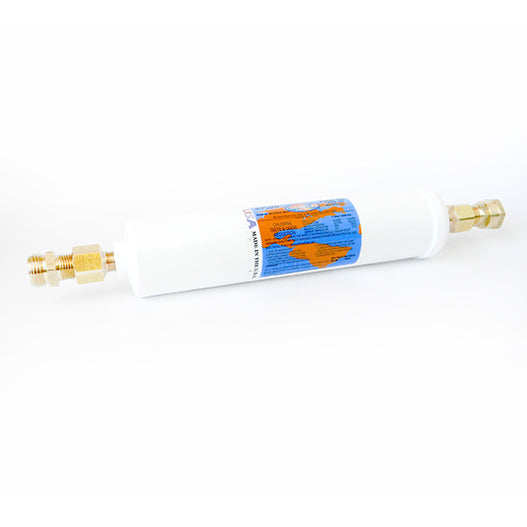
An in-line filter is usually a single-stage solution. That does not mean it is ineffective; it means the filter has a defined purpose and a limited amount of media inside a small body. It is a practical choice for improving incoming campground water without installing a larger system.
However, an in-line filter should not be treated as a universal solution for every water-quality concern. Filtration performance depends on the exact media, micron rating, water chemistry, flow conditions, and filter condition. If you are dealing with a specific contaminant, select a cartridge or system designed and rated for that concern rather than assuming a basic carbon filter addresses it.
How a canister RV water filtration system works
A canister system uses a reusable housing: or multiple housings: with a replaceable cartridge inside each one. Water enters the first housing, passes through the cartridge, and then continues through the next stage if the system has multiple housings.
A typical two-stage whole-RV arrangement might use:
- A sediment cartridge first
- A carbon block cartridge second
The sediment stage helps protect the carbon cartridge by catching particles such as dirt, sand, rust, and other suspended material. The carbon stage can then focus on chlorine, taste, odor, and the specific chemical-reduction capabilities of the selected cartridge.
A three-canister system offers another stage for a more targeted cartridge. Depending on the system and cartridge combination, that may be used for anti-scale treatment, iron and heavy-metal reduction, or specialized filtration. Some configurations use a finer filtration stage for additional protection against particular organisms or particles. Always match the cartridge’s actual specifications to your intended use.
The RV Water Filtration Systems collection includes dual- and triple-canister configurations, inside-mount options, and systems intended for different levels of filtration. The collection includes examples such as:
- An Essential dual-canister system with sediment and 0.5-micron carbon block filtration
- Enhanced systems with anti-scale filtration
- Triple-canister systems designed around iron and heavy-metal concerns
- Systems using specialized 0.2-micron virus-focused filtration
- Build-your-own canister systems with garden-hose fittings
The advantage is not simply having more housings. The advantage is being able to choose how each stage works and replace only the cartridge that needs attention.
Where each type mounts
In-line filters: hose-end simplicity
An in-line filter is usually installed outside the RV at the water connection. It may hang between the spigot and hose or rest on the ground or a small support near the hookup.
This makes it portable. You can use the same filter at different campsites without permanently attaching it to the RV. There is no bracket to install, no cabinet space to reserve, and no need to modify the plumbing.
The downside is exposure. An exterior filter and its connections are exposed to sun, weather, campground traffic, and accidental pulling on the hose. Use a potable-water hose and support the filter and connections so the weight is not hanging from a fitting.
An in-line filter can also be used with some portable or point-of-use arrangements, but it is generally not the same as an under-sink system. A hose-end filter treats water before it enters the RV, while an under-sink canister or drinking-water system may treat only the water delivered to a particular faucet.
Canister systems: exterior, compartment, or under-sink installation
Canister systems can be installed in several ways.
An exterior canister rack sits between the campground spigot and the RV inlet. This arrangement filters water entering the RV and may be convenient when the system has garden-hose fittings and a dedicated bracket. It also keeps the filtration equipment accessible for cartridge changes.
A storage-compartment installation places the system in an exterior bay or utility compartment. This can provide a cleaner appearance and protect the housings from some weather exposure. The compartment must have enough room for the housings to be removed, because cartridge changes require access below or around each canister.
An inside installation connects to the RV’s plumbing, often using PEX, and can filter water after it enters the coach. This type of installation may require more planning and plumbing work. It is important to leave enough space to shut off the water, depressurize the line, remove the housings, and catch residual water during service.
An under-sink system is usually intended for drinking water at a dedicated faucet rather than for every fixture in the RV. This is useful when you want highly treated water for drinking and cooking while keeping the whole-RV plumbing arrangement simpler.
The right mounting location depends on your goal. If you want filtration for showers, sinks, toilet supply, and drinking water, look at a whole-RV arrangement. If you mainly want drinking water, an under-sink system may be a better use of space and cartridge capacity.
Flow rate and pressure drop
Every water filter adds resistance. The question is how much restriction is acceptable for your RV, water source, and selected cartridge.
In-line filter flow behavior
An in-line filter has a compact body and a limited amount of filter surface area. That keeps it portable, but it also means the filter can become restrictive as sediment accumulates or the media approaches the end of its useful life.
You may notice:
- Slower filling of the fresh-water tank
- Reduced flow at the shower
- Lower flow when multiple fixtures are open
- A gradual decline rather than a sudden failure
A new in-line filter may provide acceptable flow for basic campground use. As the filter loads with sediment, the pressure drop can become more noticeable. If water quality at a site is poor, the filter may clog faster than expected.
The practical solution is simple: replace the filter when flow drops noticeably or when taste and odor begin to return. Do not continue using a severely restricted filter just to extend its service life.
Canister system flow behavior
Canister systems can also reduce flow, particularly when they use multiple stages or fine cartridges. A two-stage setup may have more total restriction than a single coarse in-line filter because water passes through more media.
That does not automatically make a canister system a poor choice. Canister housings provide more space for cartridges, and larger housings or jumbo systems can offer more surface area. More surface area can help maintain steadier flow as the cartridge collects sediment.
Cartridge selection matters:
- A coarse sediment cartridge may protect flow better in muddy or silty water.
- A very fine sediment cartridge may provide tighter particle filtration but load faster.
- Carbon block cartridges can affect flow depending on their construction and condition.
- Adding more stages may improve filtration coverage but also adds resistance.
- A cartridge selected for the water problem is usually more useful than simply choosing the finest available rating.
Your campground supply pressure also affects the experience. A filter cannot create pressure that is not present at the source. If the site has low pressure, a fine or heavily loaded cartridge may make the restriction more apparent. A pressure regulator is also important for protecting RV plumbing when campground pressure is high; it does not replace filtration, but it helps manage the water entering the coach.
Replacement cost over time
The purchase-price difference between an in-line filter and a canister system is only part of the decision.
In-line replacement pattern
Most standard in-line filters are disposable. When the filter is used up, you remove the entire unit and install a new one.
That offers several conveniences:
- No housing to open
- No cartridge compatibility questions
- No O-ring to inspect
- No cartridge storage
- Very little mess during replacement
The tradeoff is that every replacement includes a new filter body, fittings, and media. For an occasional camper, that may be perfectly reasonable. You may use only a small number of filters each season, and the convenience can outweigh the long-term material cost.
For a full-timer, frequent traveler, or family using a lot of water, recurring disposable-filter purchases can become less attractive. The replacement frequency depends on the filter, water quality, usage, and manufacturer recommendations. Do not rely on a calendar alone; flow, taste, odor, and visible loading are useful condition checks.
Canister replacement pattern
With a canister system, the housings remain installed and you replace the cartridges inside them. You can often change the sediment cartridge without replacing the carbon cartridge, or choose a different specialty cartridge when your water conditions change.
That creates a different cost pattern:
- Higher initial cost for housings, bracket, fittings, and possibly installation
- Lower waste because the housing is reused
- Ongoing cost for individual replacement cartridges
- More flexibility in how often each stage is changed
- More maintenance during each service
A sediment cartridge may need attention before a carbon cartridge if the water carries a lot of visible particles. Conversely, a carbon cartridge may be changed based on taste, odor, usage, or its rated service interval even when it looks clean.
The replacement filter cartridge collection makes it easier to maintain a canister system with carbon, sediment, specialty, jumbo, and other cartridge options. For travelers who use their RV regularly, the ability to keep the housings and swap only the cartridges can be a meaningful advantage.
Contaminant reduction and filtration flexibility
This is where canister systems usually have the clearest advantage.
A compact in-line unit typically combines sediment protection with carbon-based taste and odor improvement. The Omnipure K5667 configuration uses a 25-micron disc, granular carbon, and KDF. That is a useful combination for common campground-water complaints, especially chlorine taste, odors, and larger sediment.
A canister system lets you separate those jobs. For example:
- The first housing can focus on sediment.
- The second can focus on carbon filtration.
- A third can be selected for a specific concern.
- The cartridge arrangement can be changed as your travel region or water source changes.
This does not mean every three-stage system removes every contaminant. “More stages” is not a substitute for verified cartridge performance. Read the specifications for the cartridge and confirm that it is intended for your water concern.
If you are concerned about microbes, heavy metals, iron, scale, or other specific issues, consider testing the water or reviewing the campground or municipal water information when available. A water test can prevent you from paying for a cartridge that does not address the actual problem.
For general taste and odor improvement, an in-line carbon filter may be enough. For changing water conditions and a broader filtration plan, a canister system gives you more tools.
Maintenance and cleaning differences
Maintaining an in-line filter
In-line maintenance is mostly replacement and storage.
At each hookup:
- Inspect the fittings for cracks or damaged threads.
- Confirm the flow direction if the filter has one.
- Flush the filter before directing water into the RV.
- Keep the filter supported rather than allowing it to hang from the hose.
Before storage:
- Disconnect the filter.
- Drain as much water as possible.
- Keep it out of freezing temperatures.
- Replace it before the next trip if it is old, restricted, or has developed an odor.
The simplicity is the main attraction. There is no reusable housing to clean, but the entire filter is discarded when it reaches the end of its service life.
Maintaining a canister system
Canisters require more attention, but the work is manageable.
When replacing cartridges:
- Shut off the campground supply or the system’s inlet valve.
- Open a faucet briefly to relieve pressure.
- Place a towel or container beneath the housings.
- Use the housing wrench if needed.
- Remove the old cartridges.
- Inspect the housing interiors.
- Rinse and clean the housings as appropriate.
- Check the O-rings for dirt, flattening, cracking, or damage.
- Confirm the O-rings are seated correctly.
- Install the new cartridges and tighten the housings securely, without over-tightening.
- Restore water slowly and inspect every connection for leaks.
- Flush the new cartridges according to their instructions.
An O-ring that is dirty, pinched, or out of position can cause a leak even when the housing itself is not damaged. Housing care is especially important if the system is mounted in a compartment where a small leak could go unnoticed.
Do not use harsh cleaners or lubricants unless they are compatible with the housing and O-ring materials. When in doubt, follow the instructions supplied with the system and cartridge.
Winterization differences

Freezing water can damage plastic filter bodies, canister housings, fittings, and connected plumbing. Neither an in-line filter nor a canister system should be left full of water through a hard freeze.
Winterizing an in-line setup
In-line winterization is usually quick:
- Disconnect the filter from the hose.
- Drain the filter as thoroughly as possible.
- Store it in a non-freezing location.
- Drain the potable hose separately.
- Keep the filter indoors if temperatures may fall below freezing.
Many RV owners simply remove and discard an in-line filter at the end of the season, especially if it is already near the end of its useful life. A fresh filter can then be installed when travel resumes.
The key point is not to assume that removing water from the RV alone protects an exterior filter. The filter must be disconnected and drained too.
Winterizing a canister setup
A canister system takes longer because there are more components to protect:
- Shut off the water supply.
- Depressurize the system.
- Drain the housings.
- Remove cartridges if recommended for your system.
- Dry or store cartridges in a suitable non-freezing location.
- Inspect the housings and O-rings.
- Drain exterior hoses, fittings, and low points.
- Use a bypass arrangement when winterizing the RV plumbing.
A bypass helps keep RV antifreeze or other winterization materials out of the filter media. It also allows you to service or remove the filtration stages without sending winterization fluid through cartridges that are intended for potable-water filtration.
When spring arrives, reinstall fresh or properly stored cartridges, check the O-rings, restore water slowly, and flush the system thoroughly. If a housing has been exposed to freezing temperatures while full of water, inspect it carefully for cracks before reconnecting the water supply.
Which setup fits your travel style?
Weekend warrior
For occasional trips, an in-line filter is often the most convenient choice. You can keep it with the potable-water hose, connect it at the campsite, flush it, and remove it when you leave.
A canister system may still be worthwhile if your weekend trips regularly involve poor-tasting water, visible sediment, or a desire for more targeted filtration. But if the main goal is simplicity, an in-line unit is the more decisive choice.
Full-time RVer
Full-time travelers generally benefit from the serviceability of a canister system. You use more water, visit more locations, and have more opportunities to encounter sediment, chlorine taste, scale, or other water-quality differences.
A dual-canister system is a practical starting point for many full-timers because it can separate sediment and carbon filtration. A triple system may be appropriate when a specific water concern justifies the additional stage.
Retiree or seasonal traveler
Seasonal travelers should weigh use frequency against storage and maintenance. An in-line filter avoids long-term cartridge storage and makes the end-of-season process simple. A canister system can still work well, but winterization must be part of the routine.
If your RV remains parked for extended periods, plan for filter removal, draining, and protection from freezing.
Boondocker
Boondocking changes the decision because water may come from a tank, fill station, private source, or another supply with different characteristics. A hose-end in-line filter only treats water while it is connected in the filtration position. It may not address water already in the fresh tank unless you deliberately fill through the filter.
A canister system can offer more control over how you fill and use water, but it does not eliminate the need to understand your source. Consider the cartridge’s purpose, available water pressure, power limitations, storage space, and how often you can service the system.
For questionable sources, use appropriate testing and treatment practices. A standard carbon filter should not be assumed to make every untreated source safe to drink.
In-line vs. canister decision table
| Consideration | In-line RV filter | Canister RV filtration system |
|---|---|---|
| Setup | Connects directly to a hose or spigot | Requires housings, fittings, and usually a bracket or plumbing |
| Mounting | Usually exterior and portable | Exterior rack, storage compartment, or inside installation |
| Filtration format | Compact, generally single-stage | Single, dual, or triple replaceable-cartridge stages |
| Typical strengths | Taste, odor, and basic sediment improvement | Custom filtration for sediment, carbon, scale, iron, metals, and specialty needs |
| Flow behavior | Simple, but restriction may become noticeable as the filter loads | More stages can add resistance; larger housings may provide better cartridge capacity |
| Replacement | Discard the entire filter | Replace individual cartridges and reuse housings |
| Maintenance | Inspect, flush, drain, and replace | Open housings, clean them, inspect O-rings, replace cartridges, and check for leaks |
| Storage | Remove and keep out of freezing temperatures | Drain housings, manage cartridges, protect fittings, and use a bypass when appropriate |
| Upfront cost | Usually lower | Usually higher because of housings and installation |
| Ongoing cost | Repeated disposable filter purchases | Individual cartridge purchases, with more control over what gets replaced |
| Best match | Weekend trips and low-maintenance setups | Full-time travel, frequent use, changing water conditions, and customized filtration |
| Main limitation | Less filtration flexibility | More installation and service responsibility |
The practical decision
Choose an in-line filter when your priority is quick connection, basic filtration, and minimal maintenance. It is a sensible match for weekend campers, occasional travelers, and RV owners who mainly want to improve taste and odor at campground hookups.
Choose a canister system when your priority is replaceable cartridges, multiple filtration stages, and control over the treatment plan. It is usually the better long-term platform for full-time RVers, frequent travelers, and anyone who wants to adapt the system to sediment, carbon, scale, iron, heavy metals, or other identified water concerns.
If you are unsure, start with your water problem rather than the number of stages. For chlorine taste and ordinary sediment, a compact in-line option may be enough. For recurring sediment, higher usage, or a need to select different cartridges, move toward a dual- or triple-canister setup.
Remember that filtration and water-pressure protection are separate jobs. A pressure regulator helps control incoming pressure, while the filter addresses water-quality concerns. A quality potable-water hose and reliable quick connects also make either setup easier to use at the campground.
The right system is the one you can install correctly, maintain consistently, winterize safely, and replace on schedule. For a simple hose-end solution, browse the In-Line Filters collection. For a reusable whole-RV platform with selectable stages, review the RV Water Filtration Systems collection. When it is time to service a canister system, keep the appropriate replacement filter cartridges on hand before the old ones restrict flow or affect taste.