

If you camp in areas with hard water, a portable water softener can make a noticeable difference in your RV. It helps reduce the calcium and magnesium minerals that create scale on faucets, shower doors, water heaters, and plumbing components.
But choosing the right size is not always obvious. An 8,000-grain softener is smaller, lighter, and easier to store. A 16,000-grain unit treats more hardness before regeneration and is often a better fit for families, full-time RVers, or anyone who regularly camps in very hard water.
So, which is the best RV water softener for your travel style?
The short answer:
- Choose an 8,000-grain unit if you are a solo traveler or couple, usually take weekend or shorter trips, conserve water, and typically camp with moderate water hardness.
- Choose a 16,000-grain unit if you travel with a family, live in your RV, use more water, frequently encounter hard water, or want longer intervals between regeneration.
- Use a carbon and sediment filter before the softener whenever possible. Filtration and softening solve different water problems, and using both helps protect the softener resin while improving water quality.
This comparison explains how grain capacity works, how to estimate your real-world water use, what regeneration involves, and how to maintain your softener between trips.
Why RVers use water softeners
Water hardness comes primarily from dissolved calcium and magnesium. These minerals are not usually visible when the water first comes out of the faucet, but they can leave deposits behind as water evaporates or is heated.
In an RV, that can create problems in several places.
Scale inside the water heater
Your RV water heater is one of the most important reasons to consider a softener. Hard-water minerals can settle on the bottom of the tank or build up on heating components. Over time, that layer of scale can reduce heating efficiency and contribute to premature wear.
The harder the water and the more frequently you use the heater, the more important mineral control becomes. Full-time RVers and families often put much more water through the system than occasional weekend campers, so they can reach the point of needing regeneration sooner.
Deposits on faucets and fixtures
Hard water can leave white or chalky deposits around faucet aerators, showerheads, hose fittings, and drains. Deposits can restrict small openings and make fixtures harder to clean.
A softener does not replace routine cleaning, but reducing the minerals entering the RV can help prevent new buildup.
Spots on shower glass
Shower doors and walls are another place where hard-water minerals become obvious. When water droplets dry, the dissolved minerals remain behind as spots or film.
Soft water generally makes shower cleanup easier and can reduce the amount of scrubbing needed. Many RVers also notice that soap lathers more readily and that their skin and hair feel different after bathing in softened water.
Protection for RV plumbing and appliances
An RV water system contains smaller pipes, valves, fittings, pumps, and appliances than a typical house. Scale buildup can affect flow and contribute to problems in water-using appliances such as washing machines and dishwashers.
A portable softener is not a guarantee against every plumbing issue, and it does not remove sediment, chlorine, bacteria, or every contaminant. Its job is more specific: reduce hardness minerals before they enter the RV.
For a broader water-treatment setup, compare the available RV Water Filtration Systems and choose filtration based on the water conditions you encounter.
8,000 vs. 16,000 grain: what the rating means
The grain rating describes the softener’s capacity to remove hardness minerals.
In practical terms, a higher grain rating means the resin can capture more hardness before it needs to be regenerated with salt.
The two common portable RV sizes are:
| Softener size | Approximate capacity | Typical physical advantage |
|---|---|---|
| 8,000 grain | About 1,000 gallons per charge under suitable conditions | More compact and easier to store |
| 16,000 grain | About 2,000 gallons per charge under suitable conditions | More capacity and fewer regeneration cycles |
The actual gallons you receive will depend on water hardness and water usage. A softener used with 10-grain-per-gallon water will last longer than the same softener used with 20-grain-per-gallon water.
The basic calculation is:
Gallons before regeneration = grain capacity ÷ water hardness in grains per gallon
For example:
- 8,000 grains ÷ 10 grains per gallon = approximately 800 gallons
- 16,000 grains ÷ 10 grains per gallon = approximately 1,600 gallons
At 20 grains per gallon:
- 8,000 grains ÷ 20 = approximately 400 gallons
- 16,000 grains ÷ 20 = approximately 800 gallons
These figures are planning estimates, not guarantees. Actual capacity can vary with resin condition, flow, water chemistry, and how completely the unit is regenerated.

Water hardness matters as much as tank size
A common mistake is to choose a softener based only on the number of people in the RV. The water source is just as important.
Water hardness is commonly measured in grains per gallon, or GPG. A campground with moderately hard water may allow an 8,000-grain softener to last for a reasonable time. A campground with very hard water can consume that capacity much faster.
Before choosing between the two sizes, test the water at the locations where you camp most often. Water hardness can vary significantly between cities, campgrounds, wells, and private water systems.
A practical sizing formula is:
Required grain capacity = daily gallons used × water hardness × desired days between regeneration
For example, suppose two people use approximately 40 gallons per day and the campground water measures 15 GPG:
- 40 gallons × 15 GPG = 600 grains per day
- 600 grains × 14 days = 8,400 grains for two weeks
In that example, an 8,000-grain softener is close to its practical limit for a two-week interval. A 16,000-grain model provides more breathing room.
The 8,000-grain softener: best for couples and shorter trips
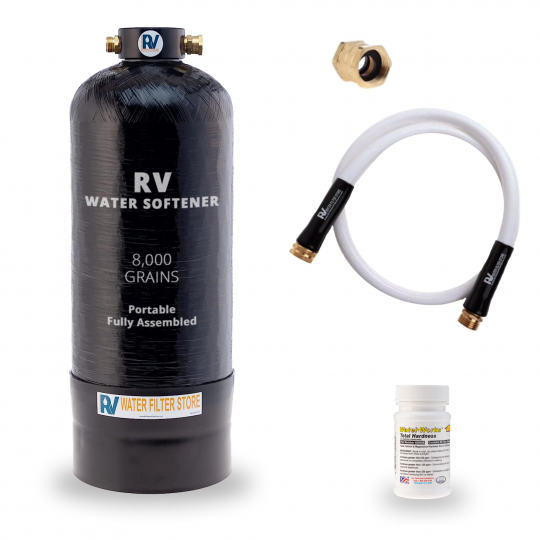
An 8,000-grain softener is often the sweet spot for RVers who want hard-water protection without carrying the larger tank.
It is a good fit for:
- Solo travelers
- Couples
- Weekend campers
- RVers who move frequently
- Smaller travel trailers and motorhomes
- Campers who conserve water
- Travelers who usually encounter moderate water hardness
- RV owners with limited storage space
The Essential Portable RV Water Softener 8,000 Grain is designed for inline RV use with standard 3/4-inch hose fittings. The listed model includes a custom hose, and the compact design is easier to handle when you are setting up and breaking down frequently.
How long can an 8,000-grain unit last?
The answer depends on hardness and water use, but one to two weeks between regenerations is a reasonable planning range for many couples using water in hard or moderately hard areas.
A couple using around 30 to 40 gallons per day might see results like these:
| Water hardness | Approximate gallons from 8,000 grains | Approximate time at 40 gallons/day |
|---|---|---|
| 10 GPG | 800 gallons | About 20 days |
| 15 GPG | 533 gallons | About 13 days |
| 20 GPG | 400 gallons | About 10 days |
| 25 GPG | 320 gallons | About 8 days |
These numbers show why the same softener may last nearly three weeks at one campground but require regeneration after a week or so at another.
If you mostly take two- or three-night trips, an 8,000-grain softener may provide plenty of capacity for the entire stay. If you stay several weeks at one location, test the water and track usage so you know when to regenerate.
The 16,000-grain softener: best for families and full-time RVers
A 16,000-grain softener is the better choice when water demand is higher or regeneration convenience matters more than minimum storage size.
Consider the larger unit if you:
- Travel with three or more people
- Live in your RV full-time
- Use an RV washing machine
- Run frequent showers and dishwashing cycles
- Stay for weeks at one campground
- Camp in areas with hard or very hard water
- Want more capacity for unexpected water use
- Prefer regenerating every two to four weeks rather than every one to two weeks
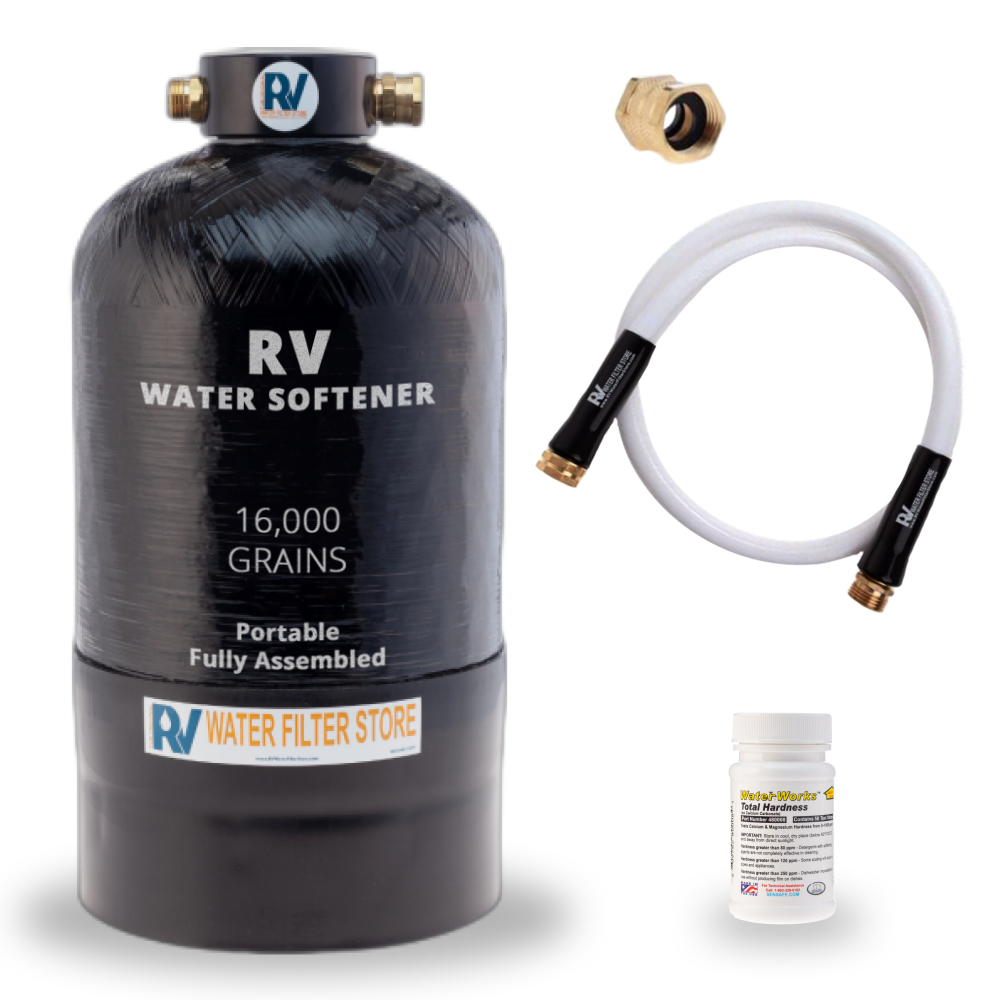
The Essential Portable RV Water Softener 16,000 Grain includes a portable 16,000-grain tank, 3/4-inch lead-free brass hose fittings, a 4-foot custom hose, hardness test strips, backwash adapters, and a shutoff.
The larger tank is physically bigger than the 8,000-grain model, so check your storage compartment before ordering. The tradeoff is more capacity and fewer salt-recharge cycles.
How long can a 16,000-grain unit last?
For many families and full-time RVers, two to four weeks is a useful planning range. Extremely hard water or heavy usage can shorten that interval.
At 40 gallons per day, the approximate math looks like this:
| Water hardness | Approximate gallons from 16,000 grains | Approximate time at 40 gallons/day |
|---|---|---|
| 10 GPG | 1,600 gallons | About 40 days |
| 15 GPG | 1,067 gallons | About 27 days |
| 20 GPG | 800 gallons | About 20 days |
| 25 GPG | 640 gallons | About 16 days |
A family may use more than 40 gallons per day, especially if it runs laundry or takes longer showers. At 60 gallons per day and 20 GPG water, an estimated 16,000-grain capacity would last approximately 13 days.
That is why hardness testing and real-world tracking matter more than a calendar-based rule.
Real-world RV water-use math
Your RV softener treats every gallon that passes through it. Showers are usually the largest daily use, but dishes, laundry, toilet flushing, cooking, tank fills, and outdoor hookups can add up.
Here is a practical example for two people:
Showers
Assume:
- Two showers per day
- Eight minutes per shower
- Approximately 2 gallons per minute
That equals:
- 16 gallons per shower
- 32 gallons per day for two showers
Actual use may be lower with shorter showers or a water-efficient showerhead. It may be higher with longer showers or a higher-flow fixture.
Dishes
Hand washing dishes might use approximately 3 to 8 gallons per day depending on habits. Running an RV or household-style dishwasher can add several gallons per cycle.
Laundry
Laundry is where family water use can increase quickly. A high-efficiency washer may use roughly 10 to 25 gallons per load, while an older conventional washer can use substantially more.
Suppose a family uses:
- 45 gallons per day for showers, faucets, and dishes
- 20 gallons for one efficient laundry load
That creates a 65-gallon day. At 20 GPG water:
- 65 gallons × 20 GPG = 1,300 grains per day
- 16,000 grains ÷ 1,300 = approximately 12 days
This example explains why a full-timer may regenerate more frequently than a couple, even when both use the same softener.
To estimate your own usage, watch your freshwater tank level or campground meter for several days. Then multiply daily gallons by the tested hardness of the water.
How filtration and softening work together
A water softener is not a water filter.
A softener is designed to reduce hardness minerals, primarily calcium and magnesium. It does not replace a sediment filter or carbon filter.
A carbon and sediment filtration system can help reduce:
- Sediment
- Rust particles
- Chlorine
- Unpleasant tastes
- Odors
- Certain contaminants, depending on the filter media and rating
The recommended general order is:
- Campground spigot
- Sediment and carbon filtration
- Portable water softener
- RV city-water connection

Putting filtration before the softener helps reduce the amount of sediment entering the resin tank. That can help protect the resin and maintain performance.
If your RV plumbing configuration requires the softener to come first, the system can still operate, but pre-filtration is preferable when practical.
For replacement filters, see the Replacement Filter Cartridges collection. Keeping spare sediment and carbon cartridges on hand is especially useful when traveling between campgrounds with different water conditions.
Regeneration: salt, flow, timing, and disposal
Portable RV softeners are regenerated by flushing the resin and recharging it with salt.
What type of salt should you use?
The product information for RV Water Filter Store portable softeners specifies ordinary table salt for regeneration. Avoid adding random salt products unless they are compatible with your specific softener and instructions.
For the 8,000-grain size, a simple one-pound box of table salt is the standard guidance listed for the unit. For the 16,000-grain size, product guidance notes that approximately four pounds may be used for a full recharge, depending on the regeneration method and conditions.
Always follow the instructions supplied with your particular model. Using too little salt may leave the resin incompletely recharged. Using substantially more than recommended creates unnecessary salt waste and may require additional flushing.
How long does regeneration take?
A normal recharge typically takes less than 30 minutes when the softener is set up correctly and water flow is adequate.
The process generally involves:
- Disconnecting or isolating the softener from the RV.
- Backwashing or flushing the tank.
- Adding the recommended salt.
- Allowing the salt solution to recharge the resin.
- Rinsing the tank thoroughly.
- Confirming that the outlet water is no longer salty.
- Returning the softener to service.
Do not send salty regeneration water into the RV plumbing. Regenerate the softener as a separate process and rinse it completely before reconnecting it.
What about flow rate?
Portable softeners need enough flow for backwashing and rinsing, but forcing water through the system at excessive pressure is not a good practice.
Use sound RV water-connection practices:
- Use a quality pressure regulator at the campground spigot.
- Inspect hoses and fittings for leaks.
- Avoid kinked hoses.
- Keep the tank upright.
- Follow the softener’s connection and flow instructions.
- Do not use the softener as a substitute for a pressure regulator.
The 8,000- and 16,000-grain models use standard 3/4-inch hose connections. The softener should be installed where it can remain stable and where hoses are not pulling sideways on the fittings.
Where should you dispose of brine?
Regeneration produces salty wastewater. Dispose of it at an appropriate dump station or other location approved for wastewater disposal.
Do not pour concentrated brine onto grass, landscaping, gardens, campground soil, storm drains, or near natural waterways. Campground rules vary, so check with the host or park office if you are unsure. If you are using a dump station, keep the discharge controlled and prevent splashing around the site.
Winter storage and maintenance
Freezing water can damage the tank, fittings, hoses, and internal components. Before storing a softener for winter:
- Disconnect it from the RV and campground water supply.
- Flush the tank with clean water.
- Drain as much water as possible.
- Leave the tank positioned so it can continue to drain.
- Store it in a dry, temperature-controlled location where it will not freeze.
- Inspect hoses, washers, shutoffs, and fittings before the next trip.
Do not leave a water-filled softener in an exterior storage compartment during freezing weather.
For regular maintenance:
- Test the source water hardness when moving to a new campground.
- Test the outlet water if the softener seems less effective.
- Regenerate before the resin is completely exhausted when camping in very hard water.
- Keep the tank upright during use and storage.
- Protect the fittings from dirt and impact.
- Replace worn hose washers.
- Pre-filter sediment whenever possible.
- Follow the manufacturer’s instructions for long-term resin care.
If the softener is stored for an extended period, flush it before reconnecting it to the RV.
Which size is the best RV water softener for you?
Use this quick decision guide.
Choose 8,000 grain if:
- You travel alone or with one other person.
- Most trips last a weekend or a week.
- You have limited storage space.
- You conserve water.
- Your usual water hardness is moderate.
- Regenerating every one to two weeks is acceptable.
- You prefer a lighter, more compact setup.
Choose 16,000 grain if:
- You travel with children or a larger group.
- You live in your RV full-time.
- You use an RV washer or dishwasher.
- You regularly camp in hard-water areas.
- You stay at one campground for several weeks.
- You want longer intervals between regeneration.
- You would rather carry a larger tank than recharge more often.
When in doubt, choose based on your hardest frequent water source and your highest realistic daily use. A couple who occasionally camps in very hard water may benefit from a 16,000-grain unit. A solo weekend traveler may find the 8,000-grain model more convenient and easier to store.
Final recommendation
For most couples and weekend warriors, the 8,000-grain softener is a practical starting point. It provides meaningful hard-water protection while taking up less space and requiring less lifting.
For families, full-time RVers, and travelers who regularly encounter hard water, the 16,000-grain softener is the more convenient long-term choice. It provides roughly twice the nominal capacity, which can mean fewer regeneration cycles when daily water use is high.
Neither size is automatically best for every RVer. The right choice depends on three numbers:
- Your daily water use
- Your campground water hardness
- How many days you want to travel between regenerations
Pair either softener with appropriate sediment and carbon filtration, test the water when you move locations, and keep the tank protected from freezing. With that approach, your softener can help reduce scale, improve shower comfort, and protect the RV plumbing that keeps your travels moving.
Frequently asked questions
Is an RV water softener the same as an RV water filter?
No. A softener reduces hardness minerals such as calcium and magnesium. A filter is designed to reduce sediment, chlorine, tastes, odors, and other contaminants depending on the filter media. Many RV owners use both.
Is 8,000 grain enough for two people?
Often, yes. For a couple using moderate amounts of water, an 8,000-grain unit can be a good fit. In very hard water or during extended stays, it may need regeneration every one to two weeks or more frequently.
How often should a 16,000-grain softener be regenerated?
Many families and full-time RVers can plan on approximately two to four weeks, but the actual interval depends on hardness and daily usage. Use water testing and the capacity calculation rather than relying only on a calendar.
Can I use a softener without a carbon filter?
A softener can operate without a carbon filter, but pre-filtration is recommended. Sediment and other impurities can shorten resin life and increase maintenance. A filter also addresses water-quality concerns that softening does not.
Can a water softener remove chlorine?
No. Chlorine reduction is the job of an appropriate carbon filter. A softener primarily addresses hardness minerals.
Can I leave the softener connected when I am away from the RV?
It is better to follow your RV and softener safety practices when leaving the rig unattended. Shut off the campground water supply when appropriate, protect the softener from heat and freezing temperatures, and inspect the system when you return.
Can I regenerate the softener at a campground?
Usually, yes, if the campground permits it and you use an appropriate wastewater disposal point. Follow park rules and keep salty discharge away from soil, landscaping, storm drains, and natural waterways.
Do I need a water hardness test?
A hardness test is strongly recommended. It gives you a more accurate way to estimate capacity and tells you whether the softener is still producing softened water after regeneration.
How should I store the softener in winter?
Flush and drain the tank thoroughly, then store it where it will not freeze. Freezing can damage the tank, fittings, and internal components.